


MERIDIAN INTERNATIONAL CENTER | OCTOBER 2026
The Open Diplomacy Playbook
A practical guide for the leaders already shaping American influence abroad
— in boardrooms, labs, city halls, locker rooms, and kitchens — whether or not they've ever thought of themselves as diplomats.
INTRODUCTION
Understanding the Open Diplomacy Playbook
The United States has never had more sources of diplomatic power operating in the world today. Much of that power, however, remains underrecognized, uncoordinated, and not used to its full potential.
The institutions built to project American influence abroad—the State Department, the Foreign Service, and the U.S. embassy network—were designed for a world where governments primarily spoke to governments. Outcomes were shaped through treaties, aid packages, and formal negotiations. That architecture remains essential. But on its own, it is no longer enough.
The State Department recognized this reality early. Since 1940, exchange programs like the International Visitor Leadership Program have brought emerging foreign leaders, entrepreneurs, and innovators into direct contact with American communities and institutions, showing that people-to-people engagement can build trust in ways formal diplomacy cannot.
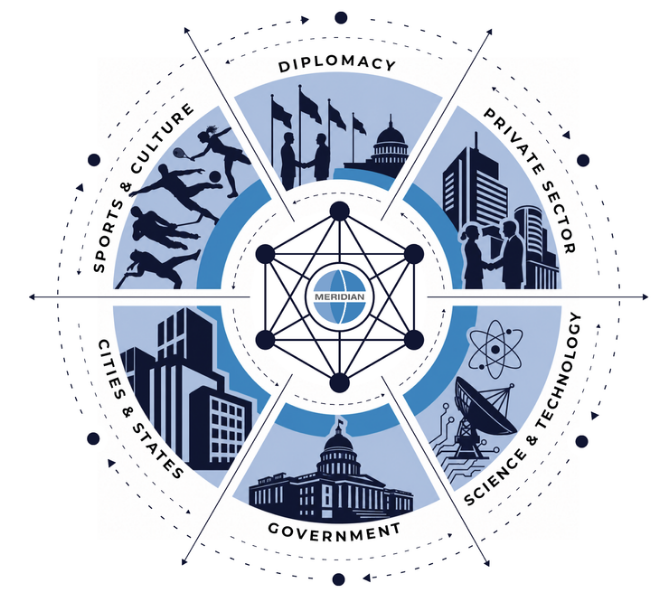
What has changed is that this kind of engagement is no longer peripheral to diplomacy; it is central to how global influence is shaped, projected, and experienced.
Today, the leaders shaping American influence in the world are no longer just government diplomats. They are also the CEOs structuring foreign investment, scientists co-authoring research across borders, mayors negotiating directly with foreign counterparts on trade, and athletes and artists reaching audiences no embassy press release ever will. Yet, most operate without a clear understanding of how their decisions and relationships fit into a broader geopolitical landscape.
This Playbook is intended to help close that gap.
The Competitive Context
Three shifts make it more urgent for American leaders to understand the stakes of their international engagement:
First, the competition has become more deliberate. Rival governments increasingly use companies, universities, cultural institutions, media platforms, and other non-state actors to advance national goals. China is the clearest example. Its Belt and Road Initiative is not just an infrastructure program, but a strategy to expand economic influence, shape technical standards, deepen political relationships, and create strategic dependence in markets where American presence is often limited.
Second, the infrastructure of influence has changed. Technical standards, investment flows, research partnerships, city-to-city agreements, and commercial platforms now shape international outcomes in ways once reserved for formal diplomacy.
Third, the window for setting norms is closing. AI, digital trade, space, energy, and critical minerals will shape global competition for decades. The countries and institutions that help set those rules early will have an advantage. Those who arrive later will negotiate from behind.
The United States possesses advantages uniquely suited to this new landscape. American influence is strongest when it is carried through independent institutions, open networks, and relationships built on trust rather than state direction.
But that advantage is frequently underleveraged. American companies, universities, cities, scientists, athletes, and cultural institutions possess extraordinary reach and legitimacy, yet often operate without sufficient strategic awareness or connection to one another. The challenge is not capability. It is coordination, context, and orientation.
What is Open Diplomacy?
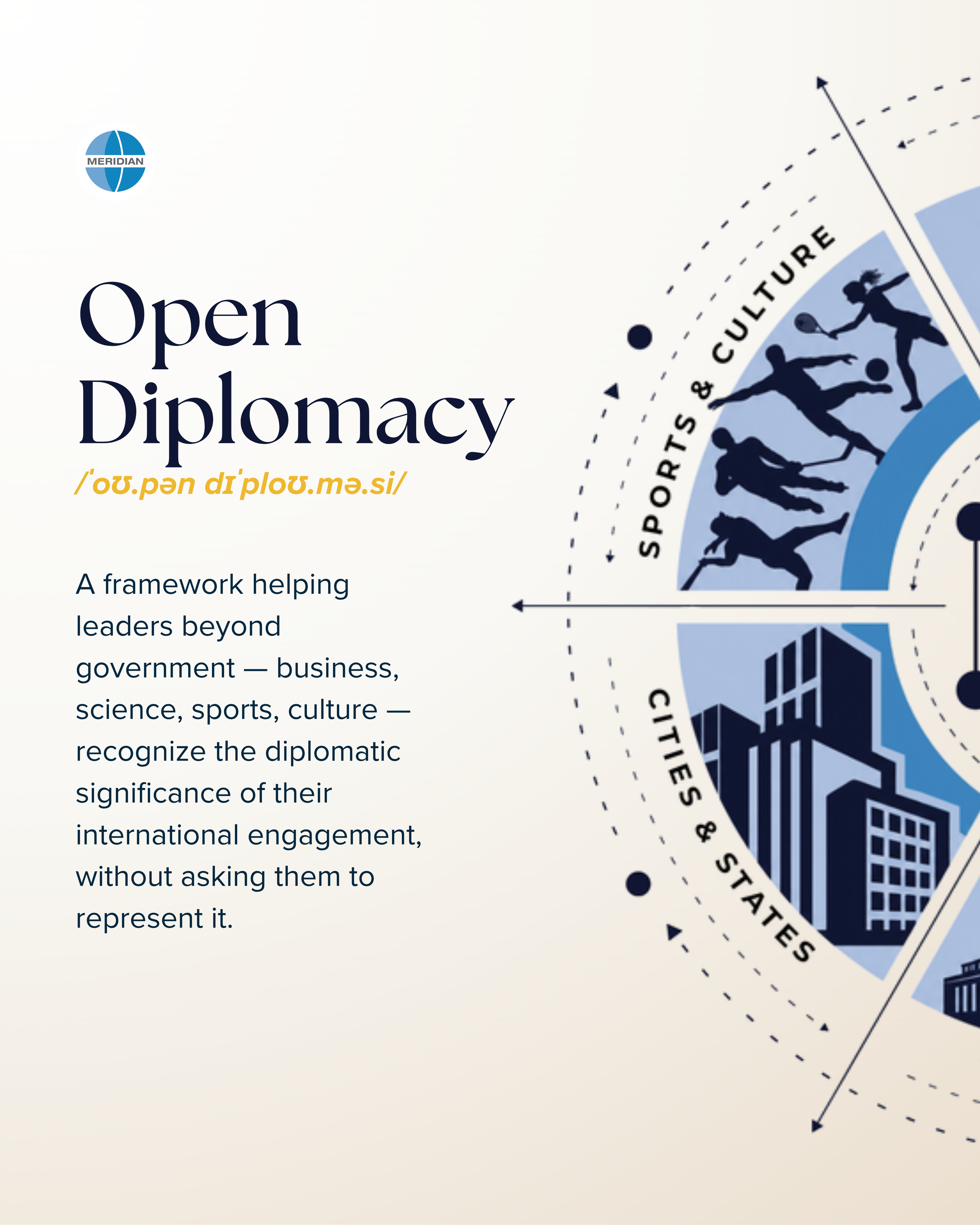
Open Diplomacy is a framework for helping leaders beyond government—
across business, science, technology, sports, culture, and civic life—
understand the diplomatic significance of their international engagement
and connecting them to the networks through which partnerships and
influence are built.
It does not ask these leaders to act as representatives of the government. Their independence is what gives them credibility. But their
decisions shape how the United States is perceived, trusted, and engaged around the world. Most are made without recognizing that
they carry diplomatic significance at all. A company can invest in local workforce development or simply extract value from a market.
A university can build a partnership around genuine collaboration, or structure it in ways that signal distrust. An athlete can engage with
local communities or move through a country in a protected bubble.
Open Diplomacy starts from the assumption that global influence in the modern world is increasingly shaped by the billions of cumulative actions and decisions of independent actors operating across borders every day.
Meridian's Vantage Point
This Playbook draws on Meridian International Center’s 65-year track record at the intersection of official diplomacy and broader American engagement—convening diplomats, the private sector, and civic leaders, and building networks that connect U.S. institutions with counterparts abroad.
The insights come from leaders Meridian works with every day: CEOs, governors, ambassadors, scientists, athletes, and cultural leaders navigating international engagement in real time. Their experience shows what builds trust, what erodes it, and how influence moves across institutions, markets, and societies.
The Playbook turns those lessons into practical guidance for a wider set of leaders, helping them recognize the diplomatic significance of their work and engage the world with greater intention.
The future of American influence will depend less on what governments say alone and more on how American institutions, companies, cities, universities, creators, and networks engage the world.
Meridian is built for that reality: a platform connecting these actors to one another, to the diplomatic community, and to the global relationships that shape trust, partnership, and influence.
From Concept to Practice: Core Principles
This Playbook is designed to move Open Diplomacy from concept to action. It focuses on four areas where non-government actors are already shaping international outcomes at scale—business, science and technology, cities and states, and sports and culture.
Each section helps leaders identify where they have influence, how their choices are perceived abroad, and how to leverage existing relationships, platforms, and partnerships to build more durable international engagement. Across every sector, the same principles apply: act with intention, preserve credibility, coordinate where useful, and build relationships before they are needed:
01
Intentionality Over Presence
Operating internationally is not the same as engaging diplomatically. The difference is whether relationships are built to last, through local hiring, community investment, and genuine cultural understanding, or treated as short-term transactions.
02
Independence as a Strength
Non-state actors build trust because they are not delivering a government agenda. Their credibility depends on that independence. The moment a company or university starts to look like an extension of Washington, the asset degrades.
03
Coordination Without Dependency
Embassy and consulate networks offer context, introductions, and alignment with U.S. interests. Most non-state actors underuse them. Draw on that support, but recognize that they are there, first and foremost, to support official government priorities.
04
Relationships Built Before They Are Needed
Crisis response is a lagging indicator of relationship quality. Organizations with deep local roots adapt fastest in a crisis. Those roots are built over years, not in response to an emergency.
05
The Work Is Already Diplomatic
International engagement always carries foreign policy implications. The question is whether decision-makers recognize that weight. Greater awareness can change choices at the margins, and those margins, across millions of actors and decisions, are where American influence is actually won or lost.
EXECUTIVE SUMMARY
How This Playbook Is Structured, and How to Use It
This Playbook focuses on four sectors where American influence is already moving at scale outside traditional diplomacy: business, science and technology, cities and states, and sports and culture.
These sectors were selected because they now shape how trust is built, capital moves, standards are set, partnerships form, and people understand the United States. Each operates differently, but the same lessons recur: relationships matter more than transactions; credibility comes from independence; government works best as an enabler, not a director; and influence is strongest when engagement is intentional.
Each section explains why the sector matters, what is changing, and how leaders can act more strategically. The Playbook closes with a Quick Reference section that turns these cross-sector lessons into practical guidance for American leaders and U.S. diplomats.
-
The Corporate Sector focuses on the expanding role of American companies as diplomatic actors in a world where business decisions increasingly shape international outcomes. It shows how firms build durable relationships, navigate geopolitical disruption, and align commercial strategy with broader diplomatic purpose. Case studies include Boeing’s technology partnerships in Brazil, Citi’s decision to remain in Ukraine, and United Airlines’ direct government engagement during COVID-19.
Contributors include:
Jane Fraser, Chair and CEO, Citi
Jim Golsen, Vice President, Center for Corporate Diplomacy, Meridian International Center
Chad Holliday, Board Member, Mission Possible Partners; Former Chair of the Board of Directors, Royal Dutch Shell (2025-2021); Former Chairman, Bank of America (2010-2014
Tom Monahan, CEO, Heidrick & Struggles
Steve Morrissey, Vice President, Regulatory and Policy, United Airlines; Chair of the Meridian Corporate Council.
-
Science and Technology highlights how researchers, engineers, and technical experts help shape the norms and standards that govern emerging technologies. The section emphasizes early engagement, the balance between commercial expertise and independent scientific authority, and the role of technologists in informing governance before rules harden. Case studies include the OECD AI Principles process, which helped establish the first intergovernmental AI standard in six months, and the broader challenge of ensuring that technical innovation advances alongside credible governance.
Contributors include:
Rob Atkinson, Founder and former President, Information Technology and Innovation Foundation (ITIF)
T.H. Charles F. Bolden Jr., Major General, U.S. Marine Corps (Ret.); 12th NASA Administrator; Founder & CEO Emeritus, The Charles F. Bolden Group
Sarah Heck, Head of External Affairs, Anthropic
Chris Sharrock, Vice President, United Nations and International Organizations, Microsoft
T.H. William Stevens, Deputy Assistant Secretary of State for West Africa, U.S. Department of State.
-
Cities and States traces how state and local leaders have become active diplomatic actors with their own networks, priorities, and leverage. It focuses on how subnational engagement can advance trade, investment, innovation, and cross-border coordination, especially where local relationships are often more durable than national ones. Case studies include California’s investment diplomacy with Japan, the Great Lakes states’ coordination with Canadian provinces, and the evolution of Sister City relationships into trade and innovation platforms.
Contributors include:
T.H. Nina Hachigian, CEO, Alliance for Local Leaders International; U.S. Special Representative for Subnational Diplomacy (2022-2025)
T.H. David Holt, Mayor of Oklahoma City, OK
T.H. Tim Kelly, Mayor of the City of Chattanooga, TN
Benjamin Moore, Chief Global Affairs Officer, Office of Mayor Todd Garcia, City of San Diego
T.H. Kevin Stitt, Governor of Oklahoma
Isaac Tawil, City Manager, City of McAllen, TX.
-
Sports and Culture turns to the ways artists, athletes, chefs, and cultural leaders build trust, open channels, and create meaningful exchange across borders. It emphasizes that cultural and sporting influence is strongest when it is used intentionally, through authentic engagement rather than message delivery. Case studies include Dizzy Gillespie’s 1956 jazz tour, which achieved in Athens in one evening what formal diplomacy had not, and the Pinning Dreams wrestling program in Jordan, which shows the same principle nearly 70 years later. This section is written primarily for practitioners themselves.
Contributors include:
T.H. Rena Bitter, U.S. Ambassador to Laos (2016-2020); Assistant Secretary of State for Consular Affairs (2021-2025)
T.H. David Cohen, U.S. Ambassador to Canada (2021-2025)
Cindy Parlow Cone, President, U.S. Soccer Federation; Former Member, USA Women's National Soccer Team
Sally Jenkins, Staff Writer, The Atlantic
Danita Johnson, President, Business Operations, D.C. United
T.H. Bernadette Meehan, Former U.S. Ambassador to Chile (2022-2025); CEO, Wikimedia Foundation
Sally Roberts, Co-Founder and CEO, Wrestle Like A Girl; Two-Time Olympic Bronze Medalist
Aviva Rosenthal, Director, Office of Global Affairs, Smithsonian Institution
T.H. Lee Satterfield, Under Secretary of State for Public Diplomacy and Public Affairs (2024-2025); Assistant Secretary of State for Educational and Cultural Affairs of the United States (2021-2025).
Building Bridges Through Business
Companies and leaders at the forefront who understand their role at the intersection of business and diplomacy don't just survive geopolitical turbulence; they turn it into a competitive advantage.
This intersection isn't new—U.S. businesses have been shaping American foreign policy since the early 1800s, from securing trade routes and shipping rights to expanding market access. From the Louisiana Purchase to the Marshall Plan, commercial interests have long influenced diplomatic strategy. What is new is the unprecedented scope and speed of today's geopolitical developments. Nearly every country and trading bloc can generate instability, and virtually every industry now faces geopolitical pressures—forcing companies across all sectors to navigate diplomatic complexities that once affected only a handful of industries.
Governments have more power to impact your business than your competitors do, especially in overseas markets. That’s why an international strategy requires a deep understanding of how to leverage diplomatic networks. In today's interconnected world, policy impacts ripple across borders, and every major business decision carries diplomatic weight, just as every diplomatic challenge creates business implications.
The key isn't whether a business leader engages in diplomacy, but whether they do so consciously, strategically, and with purpose.
Context and Metrics
American companies represent one of the nation's most significant international presences. Understanding the scale of their global presence illuminates why corporate leaders are—and have the potential to be—diplomatic actors. These numbers tell a story: American corporations operate at a scale and in places where traditional diplomatic infrastructure cannot always reach. This presence creates both responsibility and opportunity.
$7.14 trillion
in U.S. foreign direct investment abroad at the end of 2025, representing a $438.1 billion increase from 2024 and demonstrating the expanding global footprint of American business
$5.86 trillion
foreign direct investment (FDI) in the United States at the end of 2025, supporting millions of American jobs through the operations of foreign multinationals
99%
of S&P 500 companies publishing sustainability reports in 2024, up from just 20% in 2011
Forces that have Reshaped Corporate Diplomacy
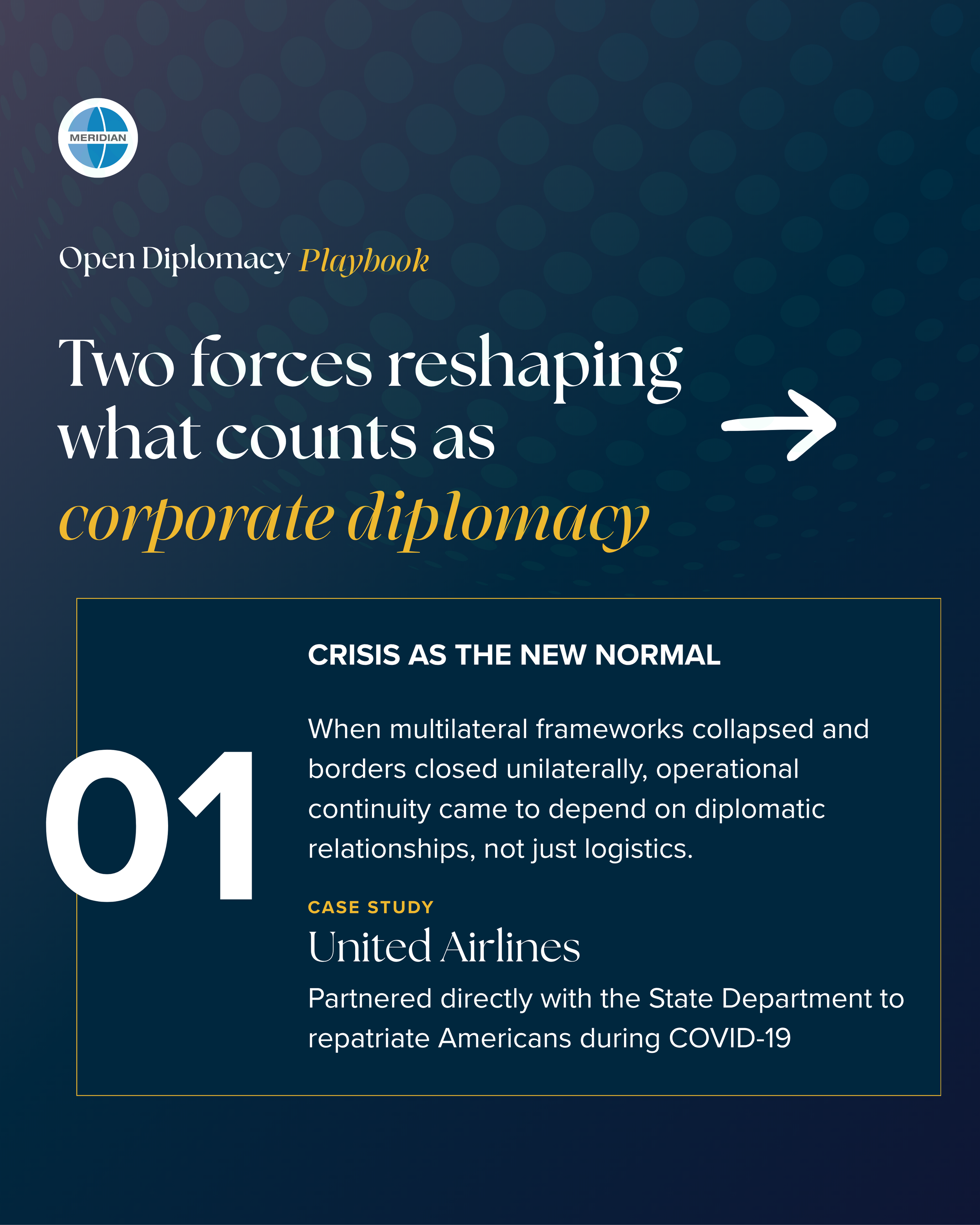
Crisis as the New Normal: The pandemic didn't just disrupt supply chains—it revealed how corporate operational continuity often depends on whether diplomatic objectives succeed or fail. When traditional multilateral frameworks collapsed, and countries imposed unilateral border controls, airlines, like United, had to develop direct diplomatic relationships with foreign governments just to maintain basic connectivity. Financial institutions maintaining operations in conflict zones became essential infrastructure for humanitarian response.
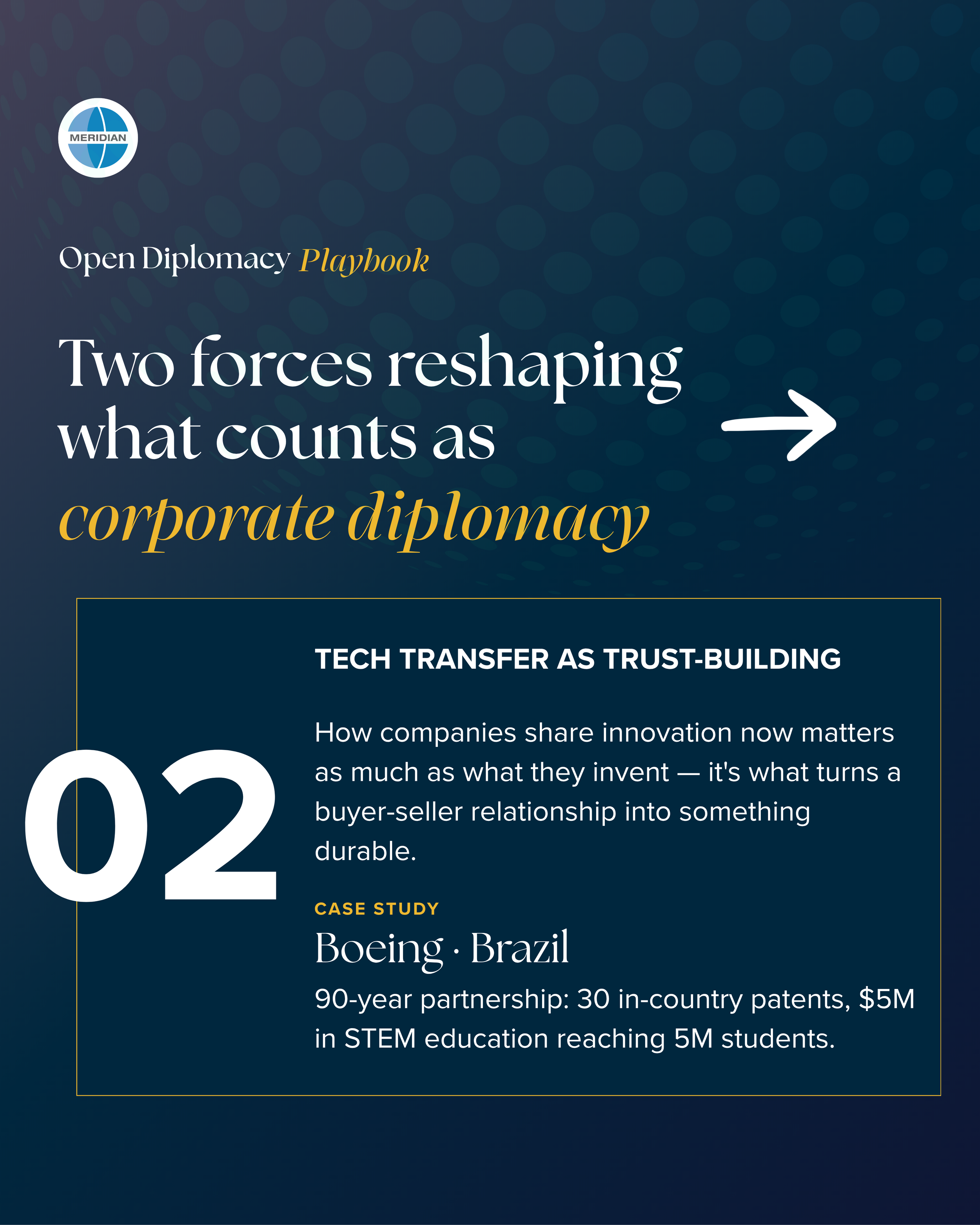
Technology Transfer as Trust-Building: Today, technology leadership can determine geopolitical influence, and how American companies share innovation matters as much as what they invent. Boeing's 90-year partnership with Brazil includes 30 patent applications filed in-country, $5 million in STEM education reaching five million students, and partnerships with universities to develop sustainable aviation fuel. This comprehensive approach creates relationships that transcend buyer-seller dynamics.
Companies that view international operations as merely transactional often struggle with local regulations, are exposed to political and geopolitical shifts, and miss out on opportunities seized by competitors with stronger networks. Meanwhile, companies that invest in their diplomatic capabilities—cultural competency, long-term stakeholder relationships, crisis coordination with embassies—create sustainable competitive advantages that financial resources alone cannot replicate.
Case Studies
The examples above show that corporate diplomacy is not a soft add-on to business strategy; it is often the mechanism that makes global business possible. Companies that understand this do more than adapt to international pressure — they build the relationships, credibility, and operational resilience that allow them to shape outcomes in their favor. The case studies that follow illustrate how leading firms turn that insight into action, using long-term partnership, crisis management, and local trust as core parts of their international strategy.
Best Practices
What these examples make clear is that the most effective corporate diplomats do not treat international engagement as a series of isolated transactions. They invest in the connective tissue of global business—trust, coordination, cultural fluency, and institutional memory—so their companies can operate across borders with greater confidence and legitimacy. The best practices below translate those lessons into a practical framework for companies, executives, and embassy partners working at the intersection of commerce and diplomacy.
Strategic Alignment: Successful corporate diplomacy aligns business objectives with governments’ strategic priorities in global issues like technology leadership, and workforce development. Companies that frame their international activities within these broader themes gain both market advantages and diplomatic support.
Local Partnership Development: It is wise to build genuine partnerships that combine business objectives with community benefits. Boeing's university collaborations and Citi's financial inclusion programs demonstrate how shared value creation strengthens long-term relationships beyond transactional exchanges.
Cultural Competency Investment: Deep cultural understanding proves more valuable than language skills alone. Companies that invest in local leadership development, maintain long-term presence, and adapt business practices to local contexts achieve superior outcomes and stronger diplomatic relationships.
Crisis Response Capabilities: Developing protocols that enable operational continuity during geopolitical disruptions is valuable. Companies with established crisis management frameworks and diplomatic relationships can maintain business continuity while supporting broader American interests during international tensions.
Metrics and Transparency: Maintaining clear metrics for impact measurement, including total amount invested, jobs created, training programs launched, and infrastructure developed is worth the time and energy. Transparent reporting builds credibility with both business stakeholders and diplomatic partners.
Embassy Integration Points
Corporate diplomacy is strongest when companies recognize that they do not have to navigate global complexity alone. U.S. embassies, especially commercial and economic sections, can help firms identify opportunities, understand risk, and build the relationships that make overseas engagement more durable. The guidance below outlines where businesses and embassy teams can most effectively work together to turn commercial presence into diplomatic advantage.
What Commercial Sections Provide
Market Intelligence: Commercial officers provide sector-specific insights, competitive analysis, and regulatory guidance that are difficult to access independently. They maintain relationships with local government agencies, business associations, and potential partners that can accelerate market entry and expansion.
Matchmaking: Embassies identify potential importers, distributors, agents, and joint venture partners based on company needs. They facilitate introductions and provide credibility through association with the U.S. diplomatic presence.
Advocacy: When American companies face discriminatory treatment, regulatory barriers, or unfair competition from state-supported enterprises, the embassy advocates for playing fields through diplomatic channels. This advocacy proves particularly valuable in markets where local competitors receive preferential treatment.
Trade Mission Support: Embassies organize sector-specific trade missions, provide venues for meetings, and convene local stakeholders. These structured programs showcase American companies and products while building networks that extend beyond individual events.
How Embassy Partnerships Work Best
Proactive Information Sharing: Leading companies brief embassy teams regularly on operations, market observations, and competitive dynamics. Companies gain insider knowledge about regulatory changes and market conditions; embassies understand private sector activities and challenges. This two-way flow creates mutual value.
Long-Term Engagement: Relationships built over years prove most valuable during crisis. Companies contacting embassies only when facing problems may find less responsive support than those with established relationships. Consistent engagement—through regular briefings, participation in embassy events, and information sharing—builds trust that pays dividends when challenges arise.
Mutual Respect for Constraints: Companies have fiduciary responsibilities limiting purely diplomatic activities; embassies must balance multiple priorities and cannot serve as corporate service providers. Understanding these constraints enables realistic expectations and productive collaboration. The most effective partnerships recognize what each party can and cannot deliver.
Challenges and Risk Mitigation
What these examples make clear is that the most effective corporate diplomats do not treat international engagement as a series of isolated transactions. They invest in the connective tissue of global business—trust, coordination, cultural fluency, and institutional memory—so their companies can operate across borders with greater confidence and legitimacy. The best practices below translate those lessons into a practical framework for companies, executives, and embassy partners working at the intersection of commerce and diplomacy.
-
Prioritize transparency in overseas partnerships and maintain consistent communication with embassy commercial teams.
Invest in long-term relationship building and cultural competency rather than short-term transactional approaches.
Develop crisis management protocols that coordinate with diplomatic channels while maintaining operational independence.
Align international business strategies with broader American competitiveness objectives in key sectors.
-
Don't assume private capital can replace official development assistance or substitute for government-to-government policy engagement. Corporate investment, while valuable, addresses different needs than traditional diplomatic programs.
Don't overextend brand-driven campaigns without long-term local investment. Surface-level corporate social responsibility initiatives without substantial commitment risk backlash and reputational damage.
Don't conflate corporate presence with diplomatic influence. Business success doesn't automatically translate to political leverage, and companies must navigate carefully between commercial and political objectives.
The most effective corporate diplomacy recognizes these limitations while maximizing areas of comparative advantage—crisis response agility, global network access, operation resiliency, innovation capacity, and long-term relationship building that transcends political cycles.
Capitalizing on the Corporate Diplomat
American companies bring capabilities that government actors cannot replicate: global operational networks reaching places that embassies do not; crisis-response agility enabling rapid decisions; innovation capacity driving technological leadership; long-term relationship-building transcending political cycles; and market credibility from commercial success.
These capabilities become diplomatic assets when aligned with broader interests, but only when realistic expectations are set for appropriate roles, sustainable commitments, and boundaries between commercial and political objectives.
Understanding the role of a corporate diplomat means recognizing that well-executed business activities often have a stronger impact than programs designed primarily for diplomatic purposes. When companies invest genuinely in local partnerships, build cultural competency, maintain transparent operations, and coordinate with embassies while preserving operational independence, they strengthen both commercial success and broader international engagement.
The architecture of modern diplomacy increasingly runs through corporate relationships, investment decisions, and operational choices. These decisions shape how millions worldwide experience American values, innovation, and commitment. Making this work requires operating at the intersection of business excellence and diplomatic awareness, where commercial success and diplomatic progress reinforce rather than compromise each other.

Architects of Global Standards and Trust
Technology and science leaders have found themselves at the center stage of geopolitics. In recent years, artificial intelligence, space exploration, biotech breakthroughs, and quantum computing have come to determine global competitiveness.
American scientists and technologists don’t define law, but they often set the technical norms and practices that travel globally—shaping economic competition and societal risk management in ways traditional diplomacy alone cannot.
Their research, standards, and domain expertise are diplomatic assets in a world in which information is currency. When scientists publish, collaborate internationally, set technical standards, create products, and advise governments, they advance knowledge while representing the United States’ values of openness, innovation, and transparency.
Tech and science leaders extend beyond traditional business and academic roles; they're potential force multipliers for American interests when governments partner effectively with them. For example, 60% of Nigeria's startups are funded by the United States, and about 80% are formally incorporated in the U.S., paying American taxes and extending influence abroad even if founders don't identify as American. Tech giants like Google and Meta function as modern equivalents to NASA, building global trust in the U.S. brand through innovative products. Including experts in science and technology and private-sector expertise early on, as they hold practical knowledge, leads to more informed policy discussions and deliberations.
The global engagement of America's scientists and technologists will determine whether American innovation spreads openly worldwide or whether others write the rules.
Much is at stake here—nations like China seek to spread their technological tools and ideas, and in doing so, grow their influence and their ability to shape the international standards that will govern global technologies. In an age where technology is more intertwined than ever with all aspects of life, the effort to preserve individual freedoms and extend democratic values depends upon smart technology policies crafted by knowledgeable decision-makers.
America’s diplomatic successes extend our innovation and technological ecosystems by engendering trust in American research and products. This trust and adoption of our technology and scientific research reinforce and deepen our international relationships, helping ensure that democratic values underpin the use of technology worldwide. That difference matters for future prosperity, security, and influence.
Context and Metrics
American technology and scientific innovation remain globally dominant, but maintaining this leadership depends on continuous international engagement and collaboration. Understanding the scale of this presence explains how scientists, technologists, and researchers alike have become essential diplomatic actors. Taken together, these figures tell a consistent story: the United States leads the world not just in the scale of its scientific and technological output, but in its ability to shape the norms, standards, and governance frameworks that determine how that output is used globally. American researchers generate a disproportionate share of the world’s highest-impact scientific work; American companies attract the majority of global venture capital into transformative technologies; and American-led initiatives—from the OECD AI Principles to the Artemis Accords—have set the foundational rules for emerging technology domains. That leadership is not self-sustaining. It requires continuous international engagement, investment in the people who connect science to policy, and a recognition that universities, research institutions, and academic communities are as much a part of America’s diplomatic toolkit as its corporations and government agencies.
$940 billion
U.S. firms' total R&D investment (2023), representing nearly 43% of all spending by the world's top 2,000 R&D investors. As of 2024, nine of the world's top 15 R&D spenders are U.S.-based.
46+ countries
have adopted the OECD AI Principles—the first intergovernmental standard on artificial intelligence—which shaped G20 and European regulatory approaches. Over 930 policy initiatives across 70+ jurisdictions now follow these principles.
35%
of world scientific and engineering articles with international co-authors include a U.S. author; U.S. publications with international collaboration increased from 19% in 2000 to 40% in 2020.
Forces that have Reshaped Science and Tech Diplomacy
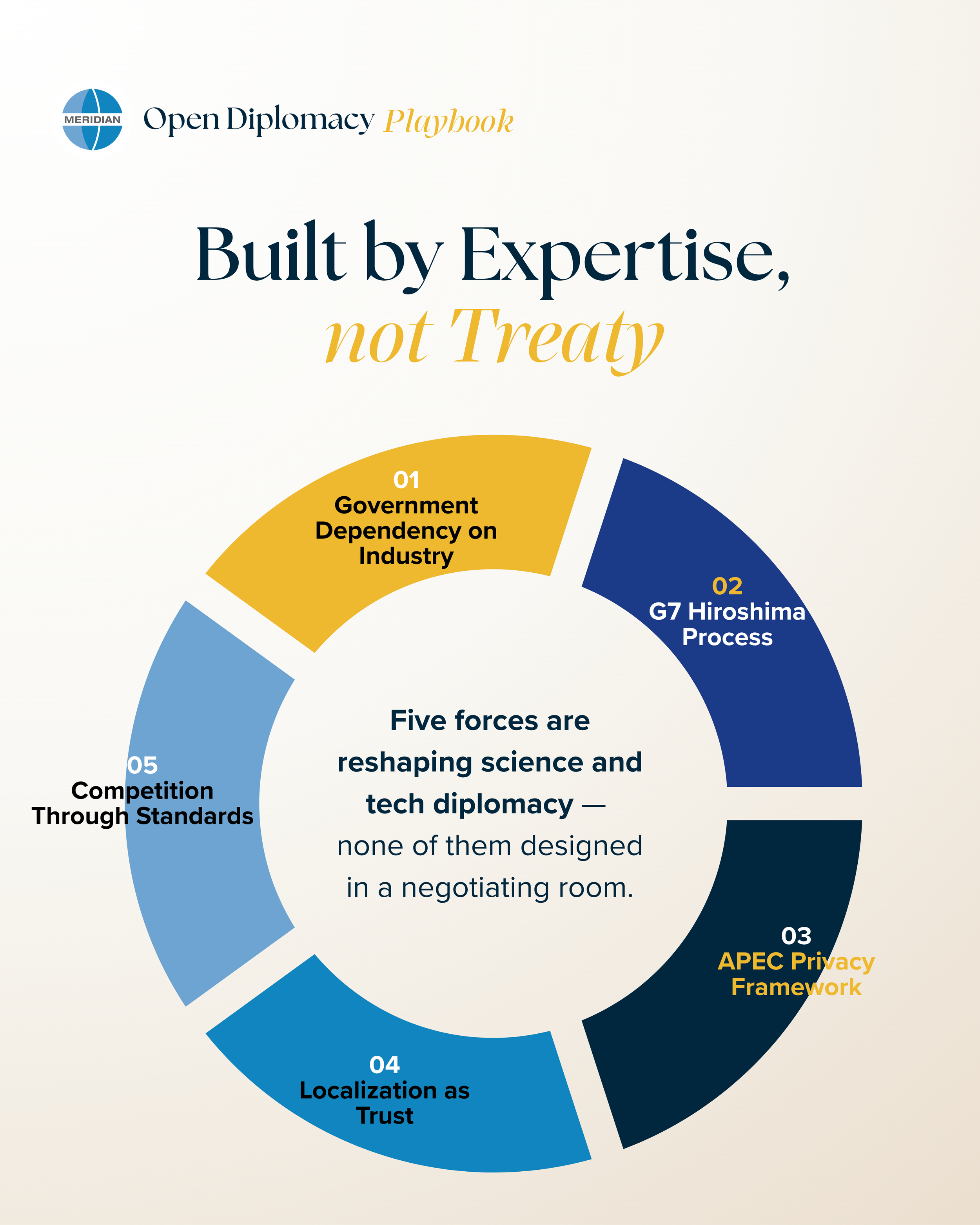
Government Dependency on Industry Expertise: Governments worldwide lack the technical sophistication to regulate emerging technologies effectively without industry input. The U.S. exemplifies this through Department of Defense software factories embedding commercial technologists, such as Kessel Run (a U.S. Air Force software factory whose founding was catalyzed by former Google CEO Eric Schmidt), Space Force’s Kobayashi Maru, the U.S. Army Software Factory, the U.S. Navy’s Project Overmatch, and the DevSecOps Platform, Platform One. This model—unique to the U.S. but envied globally—borrows agile practices to rapidly create, adapt, and adopt military technology at commercial speed.
G7 Hiroshima Process and Expert Input: Nations worldwide increasingly rely on industry expertise for AI governance. The G7's Hiroshima Process exemplifies this—advanced AI organizations collaborated with governments and academics through multi-stakeholder consultations to establish generative AI principles in seven months, far outpacing traditional diplomatic timelines.
APEC Privacy Framework Leadership: U.S. companies shaped cross-border data flow across 21 Pacific economies through the APEC Privacy Framework, balancing innovation with privacy protections. This became the foundation for Asia-Pacific digital trade, demonstrating how private-sector input creates practical frameworks that governments cannot develop alone.
Localization as Trust-Building: Tech companies' decisions to invest in local languages, cultural features, and community engagement are increasingly read as signals about American values and respect. Localizing an app into a new language can cost upwards of $50,000, with costs varying depending on the level of localization, from the number of words to be translated to the level of editing. For billion-dollar platforms, this cost may be negligible, and still extremely worthwhile. When Meta created Nowruz stickers for Persian-language Instagram users, it was perceived across the Persian-speaking diaspora as official American recognition of Persian culture.
Strategic Competition Through Technology Standards: The rules governing AI development, data flows, cybersecurity protocols, and digital infrastructure determine which countries maintain technological leadership. Whether China or the U.S. shapes these standards will determine the geopolitical balance of power for decades. Scientists from outside of government—both from academia and the private sector—are finding themselves on the inside of this competition as they work with government to ensure that their preferred views are put forward.
Take the Inter‑Agency Space Debris Coordination Committee: an agency‑led technical forum where national space agencies, including NASA, coordinate research and develop shared debris‑mitigation practices. U.S. companies contribute operational data, engineering experience, and risk insights through partnerships with U.S. regulators and space agencies, even though they are not formal members of the body itself. Those expert‑driven outputs are then reflected in U.S.‑guided standards and best practices that other countries commonly adopt, shaping de facto global norms for orbital safety that diplomats alone could not design. This demonstrates U.S. leadership without a treaty and norm‑setting through expertise rather than formal law.
Case Studies

53.2%
of global venture capital (VC) funding now flows to tech and AI sectors—62.7% for U.S. VC money—with AI becoming the fastest-growing investment category.
60 nations
have signed the Artemis Accords, a U.S.-led diplomatic initiative that establishes a non-binding set of principles to guide civil space exploration, creating an unprecedented coalition that extends beyond traditional allies.
Over 60%
of 2025 U.S. commercial launches deployed international payloads or used multinational supply chains, routinely serving European, Asian, and allied customers.
Best Practices
Effective science and technology diplomacy depends on mutual literacy. Scientists, engineers, and technical leaders must understand how their governments make decisions, whereas diplomats must recognize how expert collaboration can enable rigorous, timely governance. While the following practices are written for technical and policy partners alike, each can apply these lessons for more effective cooperation.
Educate Government Partners: Technological and scientific advancement moves faster than most governments can understand or regulate. Companies and academic institutions should prioritize educating policymakers on technical realities, e.g., what’s possible, what’s not, and what specific regulatory choices mean in practice. For universities and research institutions, this role is especially important: academic scientists can engage policymakers as neutral experts, translating peer‑reviewed research and emerging evidence into policy‑relevant insights without the perceived commercial incentives that often accompany corporate engagement. Direct, jargon-free engagement with both policy and technical officials builds trust and helps shape smarter, more adaptive regulation. Universities that treat policy engagement as a core part of their public‑service mission—through briefings, advisory roles, fellowships, and testimony—can meaningfully improve governments’ technical literacy before regulatory positions harden.
Prioritize Localization: Localization accomplishes multiple objectives. It demonstrates respect for local cultures, building goodwill that extends beyond the company to shape perceptions of American values. It makes products more usable, expanding market reach while demonstrating a commitment to reach local communities rather than simply extracting revenue.
Engage in Upstream Policy Formation: By the time legislation or regulation reaches final drafting, the opportunity to shape outcomes has largely passed. The most effective policy engagement occurs upstream, during conceptual conversations about which problems need solving and which approaches might work. Similarly, identify key venues for policy formation, like multilateral technical bodies, bilateral dialogues, regulatory agency early-stage consultations, and Congressional committee staff briefings before hearings. As the expert, being available as a resource at the outset of these conversations enables deeper policy discussions and more effectively amplifies impact.
Build for User Experience (Including Government Users): Applying design thinking to government relations can help clarify what information officials need to make informed, politically viable decisions. By simplifying technical language, anticipating policy concerns, and providing clear examples and written materials that they can use internally, can help to meet governments where they are and enhance mutual understanding and trust.
Maintain Humility About Technology's Role: Technology can solve many problems, but should not be considered a fix-all. Some challenges are fundamentally social, cultural, or political rather than technical. Recognizing these boundaries and acknowledging the limitations of technology builds credibility that can be destroyed by overclaiming.
Embed Scientists and Technologists Directly in Foreign Policy Processes: Making technical expertise available to policymakers is not enough—scientists, engineers, and academic researchers must be present at the table when consequential decisions are made, including on issues not obviously labeled as STEM topics. A sanctions discussion, a trade negotiation, or a bilateral security dialogue can all turn on technical details that only a practitioner would recognize in real time. As Schmitt et al. (2021) have argued, having scientists “in the room” for traditionally non-STEM deliberations should become standard practice rather than an occasional bonus. For example, a sectoral sanctions policy aimed at a strategic competitor may be far better calibrated—achieving the intended economic impact while limiting diplomatic blowback—if a technologist at the table can identify which specific components or processes to target rather than imposing a blunt sector-wide restriction.
Embassy Integration Points
U.S. embassies provide infrastructure that enables technology diplomacy, yet many companies underutilize these resources due to unfamiliarity with what embassies offer or the assumption that embassy support serves only large multinationals.
What Digital Attachés and Commercial Sections Provide
Technical Market Intelligence: Digital attachés are embedded in U.S. embassies worldwide and specialize in promoting commercial exchange, tackling market access barriers, and developing partnerships across technology sectors. They maintain relationships with local regulatory agencies, industry associations, and technology communities that provide advance warning of policy changes affecting American companies.
Regulatory Navigation Support: When technology companies face discriminatory treatment, data localization requirements, or regulatory barriers, embassy commercial teams engage directly with host government officials. This advocacy works particularly well when multiple American companies face similar barriers, allowing embassies to present unified concerns from the business community.
Organizing Multi-Stakeholder Dialogues with Convening Power: U.S. embassies possess the unique power to convene government, business, and civil society around technology and innovation policy. Through their commercial and economic sections, embassies facilitate introductions, share market insights, and host stakeholder dialogues aligned with U.S. diplomatic priorities. Coordinating with American Chambers of Commerce and industry peers amplifies advocacy efforts and strengthens collective credibility. Embassy‑organized technology forums frequently unite government officials, American companies, local startups, universities, and civil society organizations—creating channels for collaboration and policy discussion that rarely emerge through individual company engagement.
Academic and Research Network Engagement: In addition to commercial outreach, embassies can help connect U.S. universities and research institutions with local academic partners, ministries, and scientific bodies. These engagements support evidence‑based policymaking, open research norms, and long‑term relationship‑building that often precedes formal regulation or market entry.
Bilateral Technology Initiatives: U.S. embassies advance alignment on digital economy issues through active frameworks like the U.S.-Japan Technology Prosperity Deal, which coordinates policy on semiconductors, AI governance, and quantum computing, and the U.S.-India TRUST Initiative, focusing on quantum computing, telecommunications, defense technology, and AI safety. Science and technology leaders who participate in these structured dialogues gain direct access to policy formation while advancing broader U.S. diplomatic objectives.
How Embassy Partnerships Work Best
Proactive Relationship Building: Contact embassies proactively rather than reactively; that is, before entering new markets rather than after encountering problems. Brief commercial teams on your technology, plans for market entry, and regulatory concerns that you anticipate. This advanced engagement enables embassies to provide better support when challenges emerge.
Sustained Presence Rather Than Episodic Engagement: Participate consistently in embassy technology initiatives rather than appearing only for high-profile events. Regular engagement builds relationships that prove most valuable during crises.
Information Sharing That Benefits Embassy Understanding: Technology companies operating in-country possess ground-truth knowledge about regulatory enforcement, competitive dynamics, and market conditions that enhance embassy reporting. Sharing this intelligence helps embassies better understand markets while building reciprocal relationships in which embassies share policy intelligence with companies.
Coordination Through Industry Associations: American Chambers of Commerce and technology industry associations provide structures for coordinating engagement. Rather than each company requesting embassy support separately, coordinated industry positions enable more effective advocacy.
Challenges and Risk Mitigation
-
Build genuine collaborative relationships where both parties benefit.
Participate early in policy formation when frameworks are malleable.
Present technical expertise grounded in evidence. Acknowledge technological limitations and legitimate concerns, not just benefits.
Build relationships with local startups, universities, and civil society, not just government and corporations. This creates ecosystems that reflect American values of open innovation and entrepreneurship.
Invest in long-term commitment with sustained engagement.
-
Don't assume what markets need based on data available at headquarters. Local context often differs from central expectations. What works in one market may not work in another due to differences in infrastructure, cultural factors, or regulatory environments. Effective engagement begins with listening to local stakeholders explain their needs and constraints.
Do not expect tech to replace development assistance. Corporate technology investment serves commercial interests. Development assistance targets market failures and public goods that profit-seeking companies won't address.
Don’t isolate company engagement from government coordination. Tech companies that operate without government awareness or coordination risk undermining diplomatic objectives. Embassies need to understand what tech companies are doing locally so that diplomacy and business strategy can be coordinated.
Don’t expect democratic processes to adopt your policy position. When governments deliberate on tech policy, they may choose approaches you disagree with. Respecting democratic processes and continuing to engage—regardless of the desired outcomes—is essential to maintaining long-term credibility and influence.
When Expertise Becomes Diplomacy
The most effective science and tech diplomacy happens when technical experts—academic researchers, engineers, civil-society scientists, and industry leaders—engage authentically in international conversations grounded in genuine expertise and honesty about both opportunities and limitations. This is fundamentally different from advocacy or lobbying. It is the recognition that in a world shaped by rapid technological change, nations can't govern effectively without understanding technical realities, and companies can't operate sustainably without understanding the policy landscape.
The work of scientists and technology experts has always been global. Research is published internationally, and major conferences are highly global. Companies operate across borders. Technology spreads worldwide. The choice isn't whether to engage internationally, but how to engage internationally—by strategically helping governments understand technologies, participating in standard-setting forums, and building relationships that strengthen American innovation leadership.
Tech and science leaders represent untapped diplomatic wellsprings. Many don't think of themselves as diplomatic actors. The role of diplomats and government officials is to help them see that excellent business practices, like localization, genuine partnerships, and ethical technology, inherently advance American interests and values. The best outcomes happen when business strategy and diplomatic goals align naturally.
Cities and States as Diplomatic Actors
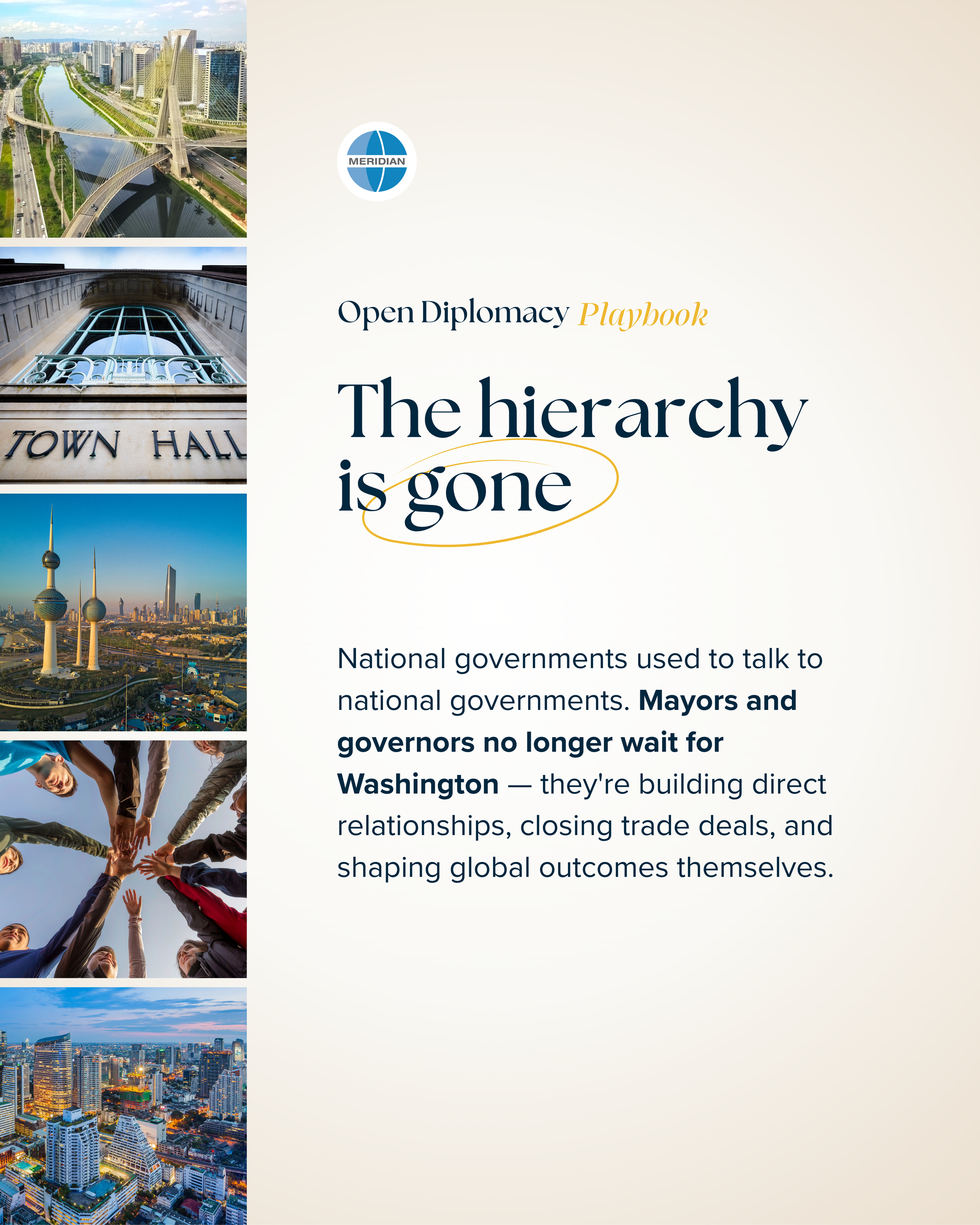
For decades, diplomatic practice assumed a simple hierarchy: national governments negotiated with other national governments, while U.S. cities and states managed local affairs within their jurisdiction. That world no longer exists. Today's existential challenges cross international borders and state lines and demand solutions that start locally. American mayors and governors no longer wait for Washington to advance their interests globally. They are building direct relationships with international counterparts, cultivating trade and investment deals, and shaping global policy outcomes in ways that complement—and sometimes bypass—traditional diplomacy.
A city or state’s international strategy is increasingly becoming a central component of its governance mission, shaping local prosperity and influencing how the United States is perceived abroad. While diplomatic authority has traditionally rested with national governments, the expanding role of state and local leaders in global policymaking reflects a broadening of who is regarded as a credible diplomatic stakeholder. Within multilateral forums, this legitimacy is increasingly acknowledged by international institutions and development agencies. A July 2025 report by the United Nations Secretary-General reaffirms the need for a stronger role of local and regional governments as they are indispensable partners in implementing global agendas. Subnational leaders epitomize America's most authentic voice abroad—representing local communities that are solving everyday problems. The federal diplomat’s playbook must now include guidance on supporting, coordinating with, and leveraging subnational diplomacy.
The benefits of international engagement increasingly flow through local channels. When a city secures foreign investment, it's not an abstract trade statistic; it's jobs in a community. When a state leads a trade mission, it opens markets for local businesses. These aren't just economic development activities, but diplomatic acts with foreign policy implications. As subnational leaders recognize and leverage their role as diplomatic actors, they can navigate the international landscape more effectively and deliver results for their constituents.
Context and Metrics
American cities and states have become significant diplomatic actors, driving international trade, foreign direct investment, and policy influence that rival those of some national governments. While the scale and momentum of subnational engagement have grown dramatically over the past two decades, this has been particularly true since the 2020 pandemic.
in foreign direct investment flowed into the U.S. in 2024 as foreign firms acquired, established, or expanded U.S. businesses. Those projects were associated with approximately 204,200 jobs at newly acquired, established, or expanded foreign‑owned enterprises that year, with total planned employment rising above 213,000 when fully operational. While federal frameworks govern international trade, implementing these investments—particularly Greenfield projects and facility expansions—often requires intensive scoping and negotiation by state economic development offices and regional chambers of commerce. Investments from allied nations like South Korea and Taiwan have been particularly strategic; for example, SK hynix committed approximately $3.87 billion to build an advanced semiconductor packaging facility in Indiana, strengthening supply chain resilience and reducing reliance on geographically vulnerable regions for critical technologies.
engage in more than 1,600 unique international engagements. Cities prioritize economic development (45%), cultural and educational programs (43%), and climate sustainability (14%) through Sister Cities (54%), sector partnerships (7%), city networks (9%), foreign delegations (11%), and trade missions (15%).
are in the Resilient Cities Network—across Africa, Asia-Pacific, Europe and the Middle East, Latin America and the Caribbean, and North America—that connect cities with the resources to maintain and enhance their urban resilience. The United States’ cities comprise nearly a quarter of the Resilient Cities Network's total membership, with 24 American cities.
now have dedicated offices for international relations, with training for diplomatic staff surging from19% in 2018 to 57% in 2024. U.S. cities are following this trajectory, but often with leaner structures. A 2024 survey from the U.S. Conference of Mayors and the Truman Center found that while 60% of surveyed U.S. cities now have staff managing international affairs, fewer than 20% have a dedicated director or manager for these portfolios. Despite these resource constraints, American cities are increasing their global footprint. In California, the number of major cities with official representatives for international affairs grew from 33% in 2010 to 77% in 2024.
Forces that have Reshaped Subnational Diplomacy
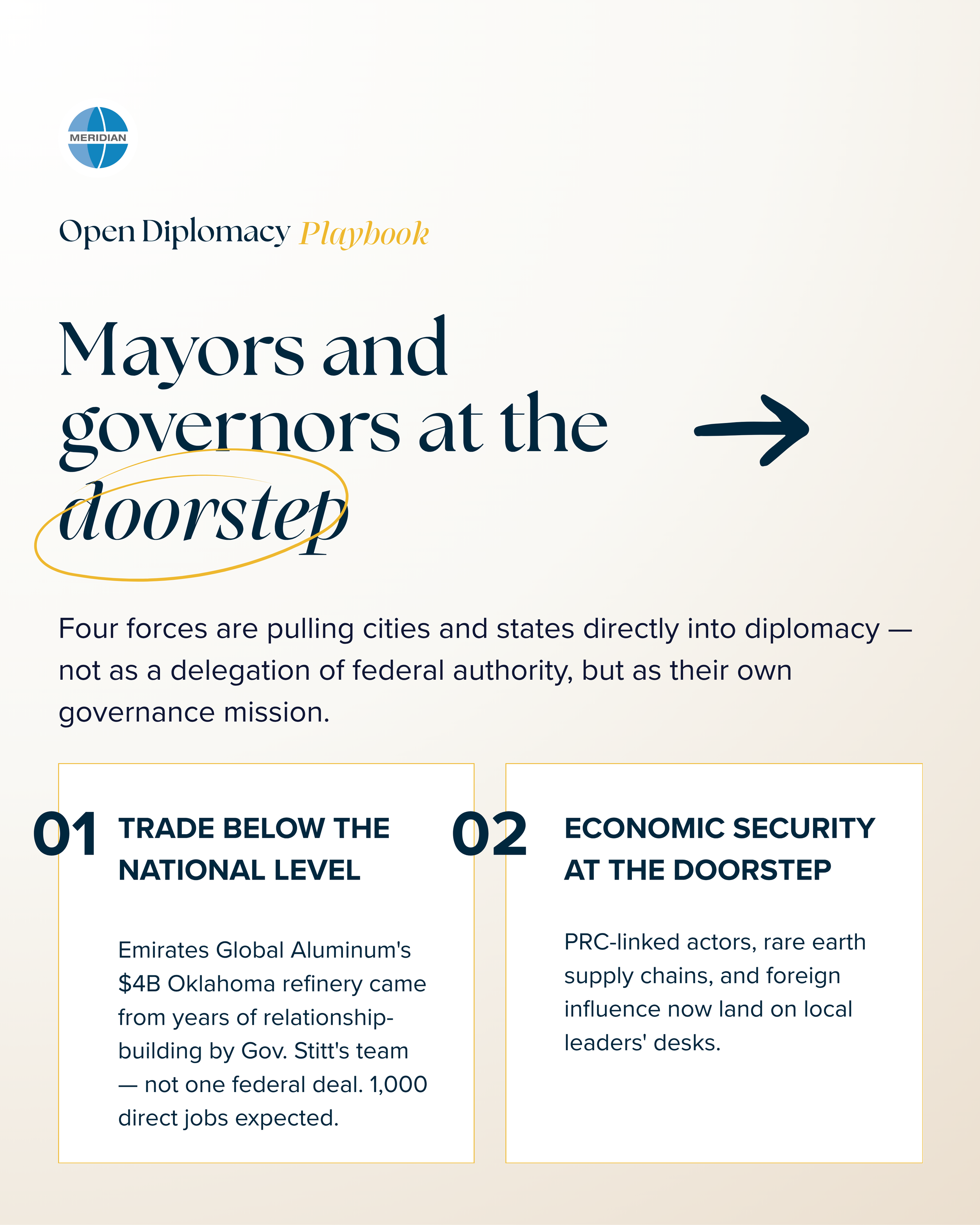
Trade and Investment Happen Below the National Level: State and city governments can effectively court foreign investors, structuring incentive packages and closing deals. When Emirates Global Aluminum announced a $4 billion aluminum refinery investment in Oklahoma, it was the result of a multi‑year relationship cultivated by Governor Kevin Stitt, the Governor’s Washington, DC Office, and the state’s commerce team, not a single federal agreement. That project is expected to create “1,000 direct jobs, 1,800 indirect jobs and enhance Oklahoma’s ability to significantly grow its base of additional manufacturing jobs,” according to the Oklahoma Department of Commerce, illustrating how subnational diplomacy translates global capital flows into local tax revenue, employment, and supply‑chain activity. As the first aluminum smelter built in America in almost 50 years, it also aligned with national supply chain security priorities.
State and Local Leaders Now Find Economic and Geopolitical Security Issues at Their Doorstep: From navigating relationships with PRC-linked actors to developing a supply chain for critical inputs such as magnets and rare earths to countering foreign malign influence, state and local leaders must be equipped with the knowledge and resources to ensure success.
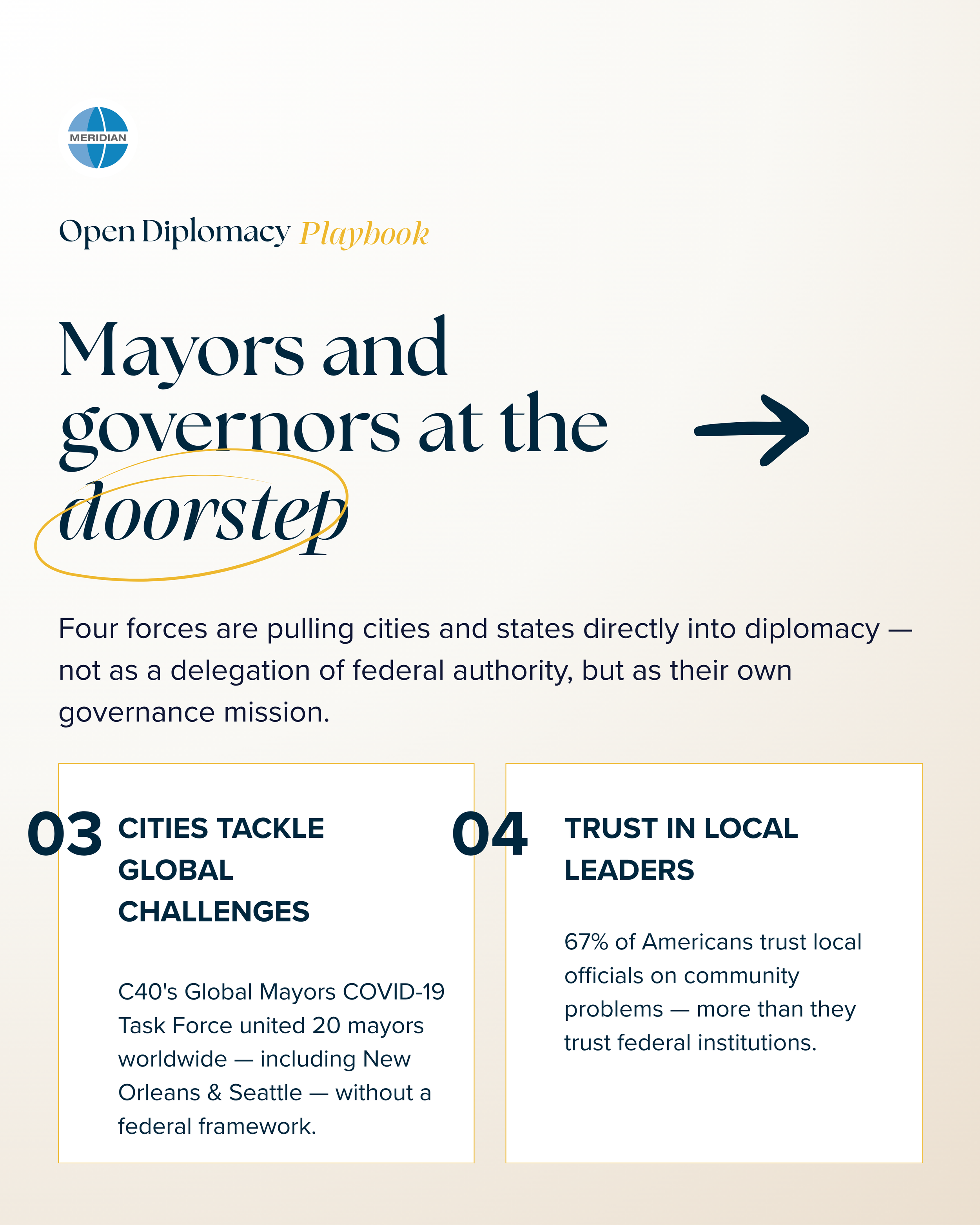
State and Local Leaders Tackle Global Challenges: Issues like pandemic response and migration are fundamentally urban challenges. For example, in April 2020, the C40 Cities launched the Global Mayors COVID-19 Recovery Task Forceto mitigate the economic harms caused by the COVID-19 Pandemic. Eleven mayors—including the Mayor of New Orleans, Louisiana, and the Mayor of Seattle, Washington—joined forces with nine other mayors from across the globe to advance economic recovery and improve public health.
People Trust Local Leaders on Economic Impact: While the federal government leads on national security, Americans consistently report higher levels of trust in local government to address issues that affect their daily lives. According to Gallup, 67% of Americans trust local officials to handle problems within their community—a level of confidence that exceeds trust in federal institutions. This 'proximity' trust allows local leaders to bridge the gap between global policy and local benefit, ensuring that international engagements are tailored to the specific economic needs and public health priorities of their constituents
Case Studies
The examples above show that cities and states are no longer passive beneficiaries of foreign policy — they are active diplomatic actors with their own networks, priorities, and leverage. When local leaders align international engagement with economic development, resilience, and community needs, they can shape outcomes that matter far beyond their borders. The case studies that follow show how subnational leaders use trade, investment, and people-to-people ties to turn local priorities into global relationships.
Best Practices
Taken together, these examples show that successful subnational diplomacy is rarely accidental. It depends on clear goals, an institutional structure, and a willingness to connect global relationships to concrete local outcomes such as jobs, investment, and resilience. The best practices below build on those lessons and offer a framework for mayors, governors, and their teams to engage internationally in a way that is strategic, credible, and sustainable.
Meridian developed a Toolkit for City, State, and Local Leaders providing tactical guidance and successful approaches to global engagement. Access the Toolkit here.
Leverage Proximity: For many jurisdictions, time and budget are the binding constraints. Rather than launching separate overseas missions for initial relationship-building, leaders can maximize impact through two existing channels:
The "Global Gateway" in Washington: Leaders can use existing trips to the national capital to brief foreign embassies and business promotion agencies on local priorities and investment opportunities.
Regional Diplomatic Hubs: State and Local leaders should actively engage the consular corps and honorary consuls in their own or neighboring cities. For instance, cities in the Southwest leverage the high density of consulates in Los Angeles, while those in the Great Lakes engage hubs like Chicago or Detroit. Inviting these officials to site visits allows them to advocate directly for the region to their home governments. This approach is most effective when local leaders use universities, international chambers of commerce, and companies with global ties as a catalyst. These partners provide technical expertise and existing networks that help translate a diplomatic visit into a substantive economic outcome. By treating local and regional diplomatic assets as an accessible global network, cities and states can expand their international footprint without the overhead of international travel.
Align International Engagement with Core Municipal Missions: International relationships should advance your city's or state's fundamental objectives—economic development, quality of life, resilience, innovation—not exist as separate diplomatic activity. The strongest subnational diplomacy integrates international partnership into core operations.
Create a Strategy and Structures for International Engagement: Ad hoc international relationships risk dispersing limited resources and rarely survive changes in leadership or funding cycles. Purposeful subnational diplomacy requires prioritization, goal-setting, and monitoring. Setting up an office of international affairs with dedicated staff, and budgeted resources that persist across administrations helps build durability.
For medium and small cities that may face prohibitive resource constraints for developing an international affairs office, consider how this international focus could be a function of an existing office or position, like an Economic Development Department or the City Manager.
Maintain Productive Dialogue with Federal Partners: City, county, and state leaders can benefit from country—or issue-specific—expertise, existing frameworks or programs, and connections facilitated by federal agencies. For example, the U.S. Department of Commerce has established numerous programs for states and cities to help drive regional competitiveness and long-term economic growth.
Leverage Sister City and Sister State Relationships: Sister City relationships represent decades of accumulated trust and people-to-people connections. These relationships are diplomatic assets that should be formally integrated into trade, investment, and innovation strategy. For new relationships, state and local leaders should think strategically about how best to engage, while prioritizing economic ties and broader areas of cooperation.
Institutionalize Trade Missions and Regional Brand Messaging: Successful subnational diplomacy requires moving beyond individual competition to develop a coherent regional brand that markets a collective value proposition (e.g., the Great Lakes or the Pacific Coast). This strategy is most effective when implemented through organized overseas trade missions that prioritize industry-specific “dividends” over symbolic gestures that resonate with constituents.
Lead with the Dividend: To prevent international engagement from being viewed as a taxpayer-funded “boondoggle,” leaders must proactively frame missions through the lens of local outcomes—specifically job creation, tax revenue, and supply chain security. Clearly articulating the Return on Investment helps insulate these programs from a narrative that can follow high-profile subnational travel.
Professionalize the Delegation: Successful missions are designed “hand-in-hand” with industry, university, and academic leaders. Including these partners serves as a force multiplier, providing the technical legitimacy that ensures the trip is perceived as professional business development rather than a political junket.
Leverage the National Guard State Partnership Program (SPP): States should utilize the SPP to bridge security cooperation and economic opportunity. These decades-long, trust-based relationships with over 115 partner nations provide an established entry point for governors to formalize investment ties. By layering commercial and academic exchanges onto existing military frameworks, states can institutionalize subnational diplomacy in markets where they already possess high-level credibility and deep institutional knowledge.
Embassy Integration Points
Even when cities and states lead, they do not lead alone. Federal partners — especially embassies, consulates, and the U.S. Commercial Service — can amplify local diplomacy by opening doors, providing intelligence, and helping translate regional priorities into international opportunity. The guidance below identifies how subnational leaders and embassy teams can work together to make those partnerships more effective.
Recommendations for U.S. Embassies Abroad
Serve as Connectors: Embassies can facilitate introductions and regular meetings between U.S. local leaders and foreign counterparts—including mayors, governors, and regional officials—to spur economic, educational, and climate-related partnerships. Examples include organizing tailored sessions for U.S. mayors and governors traveling abroad, hosting inbound delegations at U.S. embassies, or providing state and local officials with information on overseas opportunities, such as trade missions, city networks, and municipal forums. The U.S. Department of State’s Office of Public Engagement can connect you with the right people at each U.S. mission if you are unable to identify right contact.
Provide Localized Market and Policy Intelligence: Embassies can brief subnational leaders on political dynamics, regulatory changes, investment climates, and sector‑specific opportunities and risks in target countries, helping cities and states design more effective trade, investment, and cultural strategies. Beyond sharing information, embassy teams can also advocate on behalf of firms and institutions from a governor’s or mayor’s jurisdiction—raising regulatory obstacles with host‑country counterparts, convening local decision‑makers and business leaders, and signaling that subnational partnerships and project pipelines have the backing of the United States, which can reduce friction and build confidence for cross‑border deals.
Convene Multi-Stakeholder Dialogues: Embassies have significant convening power to bring together U.S. city and state representatives, foreign officials, civil society, universities, and private sector leaders for roundtables, forums, or virtual exchanges. Embassies can both enable strategic meetings that might not have otherwise happened and provide pathways to hard-to-reach locals in-country. When used intentionally, that convening power does more than create a photo opportunity; it helps local leaders identify concrete partners, de‑risk market entry, surface regulatory or political constraints early, and accelerate deals or joint projects that would be difficult to assemble on their own. Hosting city‑to‑city “networking” sessions, sector‑specific industry roundtables, or urban innovation exchanges gives subnational leaders a curated space to test ideas, compare approaches, and move from general interest to actionable cooperation.
Coordinate Crisis Response and Resilience Planning: Embassies can assist cities and states with rapid diplomatic channels during global crises—pandemics, natural disasters, or investment and visa obstacles—leveraging their networks for quick solutions that can help cities prepare playbooks for international coordination under duress.
Challenges and Risk Mitigation
What these examples make clear is that the most effective corporate diplomats do not treat international engagement as a series of isolated transactions. They invest in the connective tissue of global business—trust, coordination, cultural fluency, and institutional memory—so their companies can operate across borders with greater confidence and legitimacy. The best practices below translate those lessons into a practical framework for companies, executives, and embassy partners working at the intersection of commerce and diplomacy.
-
Develop clear criteria for evaluating potential foreign partnerships and establish engagement protocol.
Balance long-term and time-bound partnerships. When it adds real value, invest in a few relationships that can grow over time; in parallel, use targeted, time-limited projects with clear goals where capacity, politics, or timelines make that more realistic.
Work through, and in partnership with, community stakeholders that share similar goals. Cities and states can have minimal bandwidth to devote to international engagement in a sustained way. By tapping others with vested interests to help advance the agenda and identifying such actors, it can clarify whether the planned engagement delivers value to the community.
Build a diverse network of advisors and consult with diplomatic and national security officials when appropriate.
Conduct due diligence and risk assessment when evaluating new relationships. State and nonstate malign actors increasingly seek to influence and interfere with U.S. local governments, causing reputational damage and national security risks
Maintain regular embassy contact when preparing and executing trade missions abroad to discuss objectives and gather economic and political intelligence.
Always consider public engagement and messaging. A city’s or state’s constituents are watching and expecting clear results. Partner with other respected, trusted regional stakeholders to jointly communicate the benefits to the community.
-
Don't expect states and cities to replace national government diplomacy. States and cities cannot negotiate binding international treaties or handle matters of national security. Subnational diplomacy is complementary to national diplomacy, not substitutive.
Don't accept agreement language contradicting your values or policies. Use your leverage, impose your conditions, and reject pressure to change a stance or to criticize national policy in return for investment or other benefits.
Don't expect sustained engagement without an institutional structure. An ad hoc international activity that depends on volunteers or individual champions rarely resist political transitions.
Don't compete destructively within regions. When neighboring cities and counties engage in a race to the bottom for the same investment, the region loses overall. Coordinated regional strategy outperforms internal competition.
Effective subnational strategies start with local responsibilities and work outward. In practice, city, county, and state leaders are most successful when they focus on a manageable set of international priorities that clearly support existing goals—such as attracting investment, strengthening key industries, improving infrastructure, or accessing technical expertise—and provide the public with transparency about those objectives. When cross‑border engagement is explicitly tied to what the jurisdiction already needs to deliver for its residents, it is easier to sustain over time, easier to explain to stakeholders, and more likely to produce concrete outcomes that justify continued effort and resources.
When Local Leaders Think Globally
American cities and states bring capabilities that the national government alone cannot replicate: direct access to local markets and communities; an understanding of regional competitive advantages; long-term relationships that transcend political cycles; and credibility from authentic problem-solving within their jurisdictions.
These capabilities become diplomatic assets when aligned with broader interests, but only when realistic expectations are set. Subnational leaders operate within delegated authority, coordinate with the federal government, and recognize that trade and investment happen within national policy frameworks, not outside them.
To be most effective, it is crucial to recognize that when cities and states invest genuinely in international partnerships, develop cultural competence, maintain transparent operations, coordinate with embassies, and preserve decision-making autonomy, they strengthen both local economic success and broader American international engagement. Similarly, it is important that state and local governments work alongside the federal government to encourage investments aligned with American national security interests.
The architecture of modern diplomacy today distributes power across American cities and states. These local leaders shape how millions worldwide experience American values, innovation, and commitment. Making this work requires operating at the intersection of local mission accomplishment and diplomatic awareness, where economic development and diplomatic progress reinforce rather than compromise each other.

Building Bridges Through Authentic Engagement
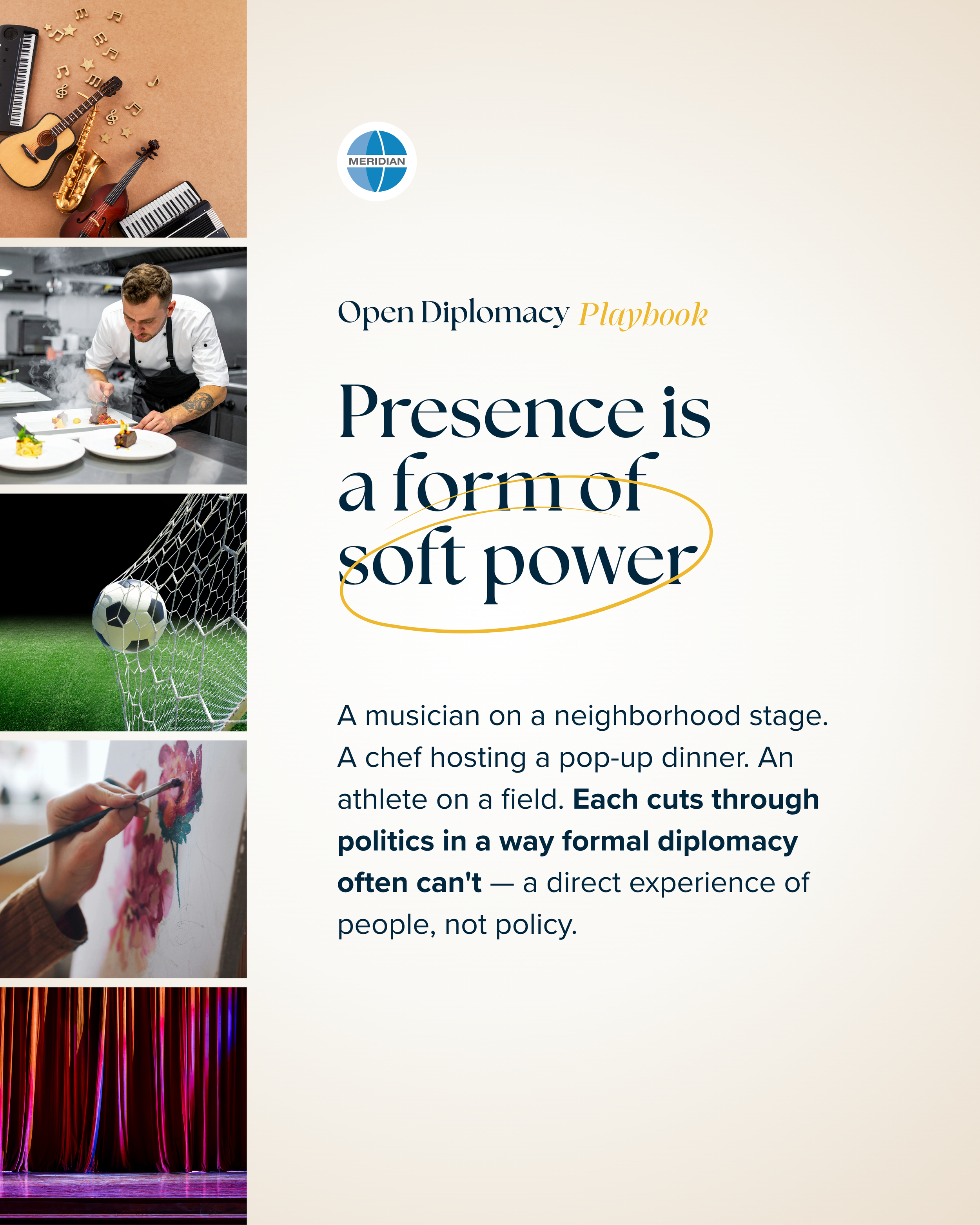
Sports and culture are among America’s most powerful diplomatic assets, creating human‑scale connections where formal diplomacy often cannot. A visual artist installing work in a community space, a musician on a neighborhood stage, a chef hosting a pop‑up dinner, or an athlete on a field can cut through national politics and cultural barriers, offering audiences a direct experience of people rather than policy. These encounters happen at every level—from museum exchanges and touring ensembles to college teams on foreign tours, from Grammy‑winning musicians and acclaimed choreographers to emerging artists and local creatives.
For many artists, writers, and chefs, however, the idea of “doing diplomacy” can feel at odds with the very reason they create in the first place. Their practice is often grounded in freedom of expression and a resistance to being told what to say, which can make the notion of representing a government or nation feel uncomfortable, even suspect. Athletes, by contrast, are more accustomed to speaking for a team or country and to self‑editing in public, though they too rarely think of themselves as diplomats.
The opportunity is not to turn any of these practitioners into political messengers, but to recognize that their presence, values, and willingness to engage authentically with local communities already shape how the world perceives the United States—often more powerfully than formal government messaging.
This chapter is written primarily for those practitioners themselves—artists, musicians, curators, chefs, designers, athletes, and influencers—and secondarily for the partners who work with them, from embassies to festivals and clubs to universities, leagues, and brands. It offers practical ways to approach this work with clarity, care, and impact while staying true to their own voice.
Context and Metrics
American athletes and artists have extraordinary global reach thanks to a range of market-driven platforms and government-supported programs. Here are some examples—both from less pronounced public-sector initiatives to the largest of stages—and how this reach can be channeled into deeper relationships rather than left on autopilot. Together, these metrics show that American athletes, artists, and cultural leaders already command vast, trusted audiences—positioning everyday participation, performance, and presence abroad as scalable tools for shaping perceptions, building relationships, and advancing U.S. influence.
Arts Envoy Programs
The U.S. Department of State’s Arts Envoy Programs send American performing and visual artists, poets, dancers, directors, curators, and chefs abroad for five-day to six-week residencies, building long-term relationships with foreign audiences and institutions. Among State-funded cultural programs, Arts Envoys offer the deepest per-person reach, reaching communities that rarely experience major cultural events or celebrity tours.
$1.2 trillion
or 4.2% of GDP, to the U.S. economy in 2023, is contributed by the U.S. arts and cultural industries growing at twice the rate of the overall economy. The sector also generated a $36.8 billion trade surplus in cultural goods and services exports.
96%
US Artists International participants made new international professional contacts during their program experience, while 92% reported creative benefits and 77% gained social media followers through their international engagement.
Forces that have Reshaped Sports and Cultural Diplomacy
Social Media Platforms Can Democratize Cultural and Sports Diplomacy: Social media platforms such as X, TikTok, and Instagram have fundamentally democratized the landscape of cultural and sports diplomacy. In the past, diplomacy was strictly the domain of governments and wealthy organizations. Social media has transformed the speed and reach of diplomatic communication. Today, a single athletic achievement shared on social media, a cultural performance livestreamed globally, or an athlete’s message on TikTok can shape international perceptions faster than traditional diplomatic channels—engaging in real-time public diplomacy with audiences that may never read an official State Department statement. The 77% increase in social media followers experienced by USAI participants demonstrates the tangible, lasting reach these exchanges generate. It also demonstrates how de facto diplomacy can serve to both build goodwill for the U.S. and raise the practitioner's profile—bolstering personal brand through amplified exposure, which can translate into new professional opportunities and sponsorships.
Influencers Have Become Unintentional—and Contested—Diplomatic Actors: The Dubbed "influencer diplomacy", this phenomenon describes the varied ways creators engage in diplomatic processes, whether through official collaborations, spontaneous content, or simply by traveling and being watched through their numerous social media channels. A food creator documenting a market in Marrakech, a fitness influencer training with locals in Kenya, or a travel vlogger navigating daily life in a country Americans rarely visit—all are shaping how their audiences understand that place and its people, whether or not they think of it that way. America's competitors have recognized this and moved to institutionalize it. In early 2025, China's All-China Youth Federation launched a structured program offering American creators with more than 300,000 followers all-expenses-paid cultural exchange tours, curated itineraries designed to generate authentic-seeming content about Chinese infrastructure, technology, and culture. American YouTuber IShowSpeed's 2025 China visit, streamed to nearly 9 million viewers, was hailed by Chinese state media as a soft-power success precisely because it came from an individual rather than the government. China has run similar programs with Indonesian influencers to reshape public perception in a historically skeptical market. Whether influencers recognize their role in this arena or not, others already have.
Global Competition for Soft Power Has Intensified as Emerging Powers Invest More Strategically: The bipolarity of the Cold War model has long become obsolete. Today’s arena is multipolar: emerging economies, regional powers, and non-Western actors leverage cultural and sporting platforms to assert influence and reframe global narratives. Countries are bidding to host major sporting events—the Olympics, the FIFA World Cup—to enhance national prestige, build international appeal, and shape global perceptions. Qatar’s hosting of the 2022 FIFA World Cup illustrates this strategy, using the mega-event as a platform for international engagement and visibility, cultural exchange, and to attract tourism and investments. The Gulf region, more broadly, has adopted what might be called a “full-spectrum” cultural soft-power strategy—one that combines mega-sporting events with art, heritage, and global conferences into a coherent national brand. The United Arab Emirates offers some of the most notable examples: Dubai hosted Expo 2020 (attracting participants from 192 countries), the UAE hosted the UNFCCC COP28climate conference, and in November 2025, Dubai staged the ICOM General Conference— the largest global gathering of museum professionals—for the first time ever in the Middle East, Africa, and South Asia region. Abu Dhabi’s Saadiyat Island cultural district, anchored by the Louvre Abu Dhabi(which drew nearly1.4 million visitors in 2024 alone), gained two new museums in 2025. The UAE explicitly established a national Soft Power Council and has publicly linked its cultural investments to tourism, economic development, and changes in global perception. Today’s wildly competitive landscape means that cultural and sports diplomacy is no longer—and cannot be—a peripheral tool. It has become a central instrument of statecraft, with significant financial investment and strategic intentionality.
The Emergence of Esports and Gaming: Video games and esports are a relatively new tool for diplomatic engagement, offering persistent, globally accessible, and youth-oriented engagement, particularly as global demographics shift toward younger, digital-native generations. This reflects an important generational nuance: traditional cultural exports are not the only ways to effectively engage populations who spend hours daily in digital environments. In the 2025 study, “Mapping The Landscape of Game-Based Cultural Diplomacy: A Bibliometric Analysis of Global Trends and Influential Research” by Muhammad Abdul Azis and Nadia Angelina of Universitas Brawijaya, found that Japan, Poland, and China are among the nations utilizing video games and esports to promote national identity, cultural narratives, and values, reaching millions internationally. The State-backed Chinese gaming industry incorporates traditional Chinese cultural elements—myth, history, and aesthetics—into internationally consumed games like Black Myth: Wukong and Honor of Kings, further strengthening its global footprint. Japan has a renowned video game industry and has used its canonical characters, such as the then-Prime Minister of Japan, Shinzo Abe, dressed as Mario, during the Rio 2016 Olympics closing ceremony to promote the 2020 Tokyo Games. In a 2011 visit to Poland, Polish Prime Minister Donald Tusk presented President Barack Obama a collector’s edition copy of The Witcher 2: Assassins of Kings as an official diplomatic gesture, intended to symbolize modern Poland's place in the global economy and its success in the high-tech entertainment software industry. The analysis shows a growing number of studies (2015–2024) dedicated to 'game-based cultural diplomacy,' indicating that video games and esports are being institutionalized as instruments of digital diplomacy not only by private companies but increasingly by states and policymakers.
Case Studies
The examples above show that sports and cultural diplomacy work best when they are rooted in authenticity, sustained relationships, and a clear sense of purpose. Whether the setting is a basketball court, a concert hall, a wrestling mat, a kitchen, or a stadium, the most effective practitioners do not simply represent the United States — they create space for genuine exchange, mutual respect, and shared experience. The case studies that follow illustrate how athletes, artists, chefs, and cultural leaders turn presence into influence, using their craft to build trust, broaden understanding, and connect people across borders in ways that formal diplomacy often cannot.
70 countries
The U.S. ranked among the top five sources for most-streamed songs in 70 countries in 2024, according to Spotify’s Top 200 data across 73 nations. American artists captured 79% of streams in the domestic market and 55% in the UK, while recent Billboard Global 200 data shows U.S. acts accounting for 60% of the global chart’s top 10 hits.
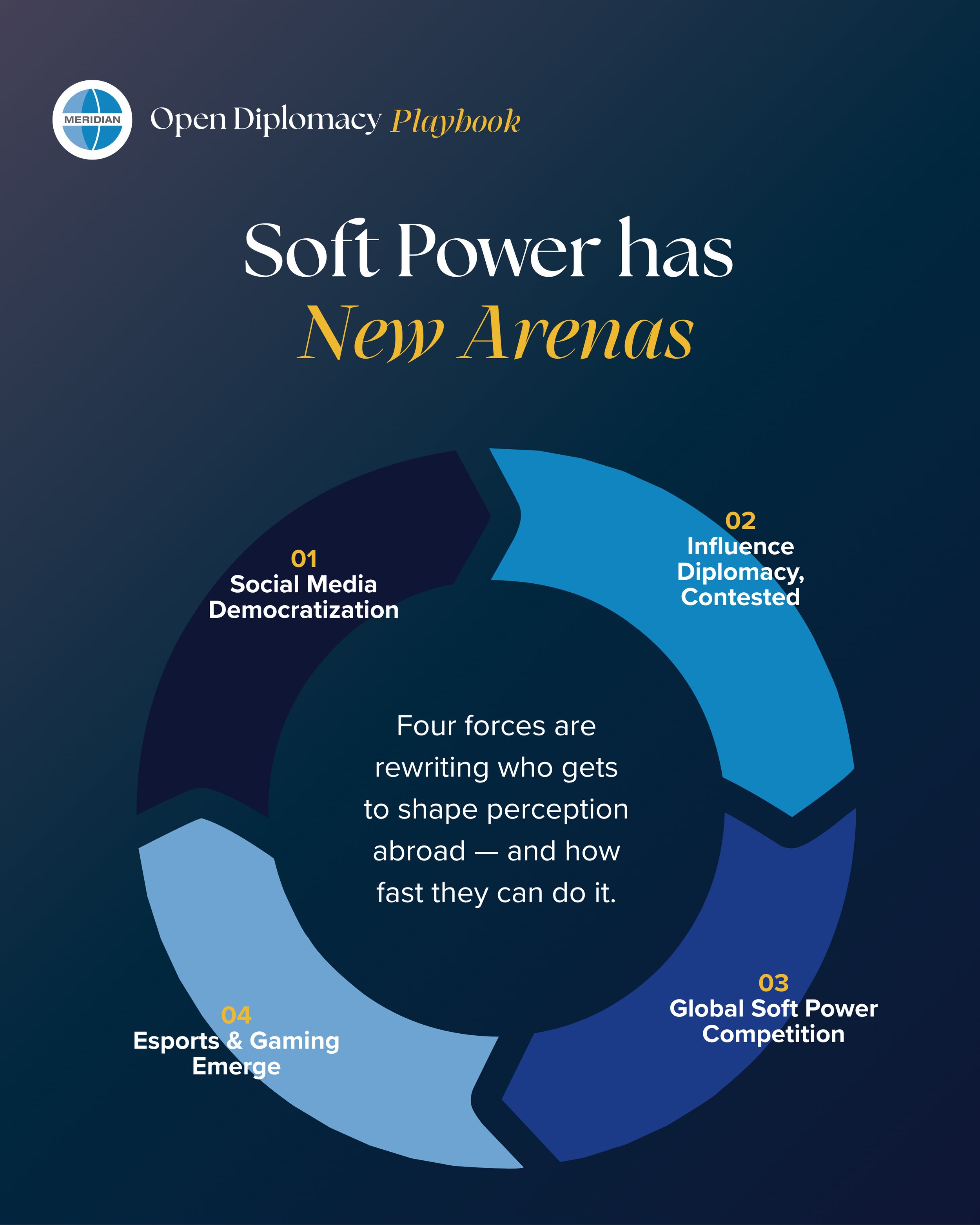
60%
of American subscription video-on-demand content is consumed across the Indo-Pacific, underscoring the reach of U.S. entertainment well beyond the domestic market. In Saudi Arabia, Hollywood films accounted for 53% of all box office titles in 2024.
5 billion people
—84% of the potential global audience—followed the 2024 Paris Olympic Games, with 10,500 athletes from 206 National Olympic Committees competing across 329 medal events. The Paris Paralympics generated 763.3 million hours of dedicated live coverage worldwide—83% more than Tokyo 2020—with significant increases in viewership for both the Opening and Closing Ceremonies.
across the NBA’s social platforms during the 2023–24 season, up 22% from the previous year. More than 75% of the league’s social media followers are outside the United States, giving American basketball an enormous built-in global audience.
29 NFL clubs
hold international marketing rights across 21 markets through the league’s Global Markets Program, supporting year-round fan engagement, grassroots initiatives, and talent development abroad. The NFL also doubled its international games from four to eight per season beginning in 2025, while its International Player Pathway Program has placed 40 international players on NFL rosters since 2017. Since 2024, every club has a reserved practice-squad slot for a qualifying international player.
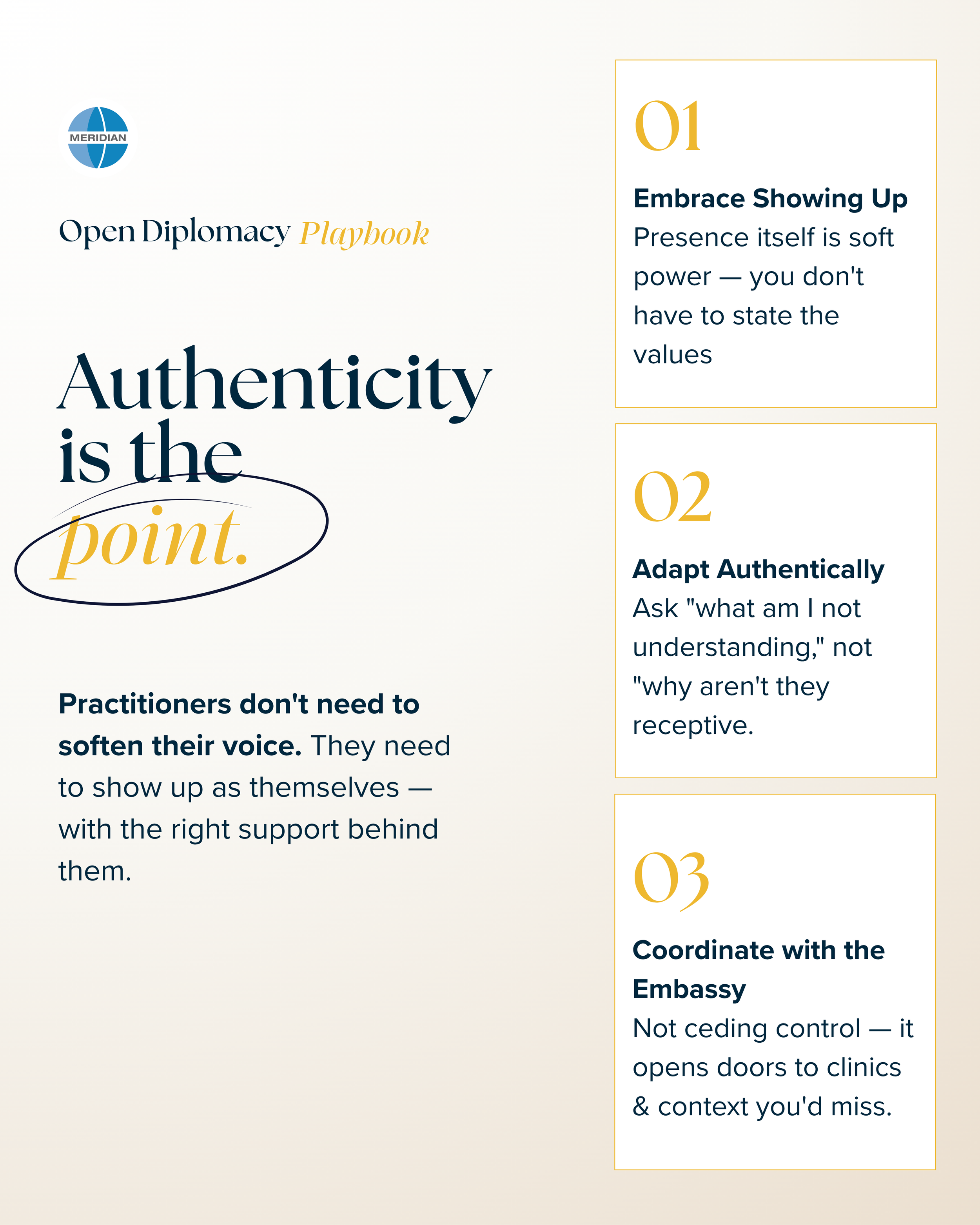
From Context to Action
The data points and examples above establish the scale and competitiveness of today’s cultural diplomacy landscape. But understanding that landscape is only useful if it leads to action. We now shift from context: why sports and cultural diplomacy matter, to practice: how individual practitioners and their institutional partners can approach it well.
The best practices that follow are intended first and foremost for the practitioners themselves—artists visual artists, musicians, curators, chefs, dancers, designers, athletes, and digital influencers. It is secondarily for the embassy cultural affairs officers, nonprofit program managers, and corporate partners who work alongside them. The tips apply regardless of whether a practitioner is participating in a formal State Department program or simply traveling abroad and choosing to engage authentically.
One note before proceeding: authenticity is not a complication to be managed—it is the point. Artists who feel that “doing diplomacy” means softening their voice or becoming a spokesperson for positions they don’t hold will find the work hollow. Athletes who perform goodwill without genuine curiosity will not build the trust that makes cultural exchange meaningful. The best practices below are designed to help practitioners show up fully as themselves—and to show why that, precisely, is the most powerful thing they can offer.
Best Practices
Effective science and technology diplomacy depends on mutual literacy. Scientists, engineers, and technical leaders must understand how their governments make decisions, whereas diplomats must recognize how expert collaboration can enable rigorous, timely governance. While the following practices are written for technical and policy partners alike, each can apply these lessons for more effective cooperation.
Embrace the Art of Showing Up: Recognize that in sports and the arts, impact often begins simply by showing up—whether it be through authentic participation, performance, or community interaction. Athletes and cultural leaders embody values like teamwork, creativity, resilience, and inclusion without needing to articulate them directly. A soccer player joining a local youth practice, a dancer sharing space in a community studio, or a band collaborating with local musicians can all model mutual respect and possibility. Presence becomes a form of soft power—showing that exchange is a shared experience, not a transaction—and can inspire connection even where language or politics divide.
Adapt Authentically to Local Context: Respect local culture, but don't compromise on integrity. Research before arriving and attempt to learn a few basic words of the native language. Understand that local customs regarding gender, physical contact, and social hierarchy might not resemble those in the United States. When you encounter resistance or misalignment, ask yourself: “What am I not understanding?” rather than “Why aren't they being receptive?” This sort of adaptation demonstrates respect and allows your message to resonate more because it shows you took local context seriously.
Coordinate with the Embassy Before Arrival: This is not about ceding control. Notifying the U.S. embassy of your upcoming performance, competition, or visit can open doors to opportunities you might not otherwise have access to, such as community clinics, youth workshops, or volunteer events that allow deeper engagement with local populations. Embassies can also provide valuable insight into local politics, culture, and sensitivities, helping you navigate potential challenges thoughtfully. In doing so, you both enhance your experience and support your country’s broader mission of connection and goodwill.
Embassy Integration Points
How Missions Can Activate Sports and Culture Diplomacy
Engage Local Legends and Cultural Icons: Involve local athletes, artists, or cultural icons who hold deep community respect. Their participation helps transform embassy-supported events into shared experiences rather than foreign exhibitions. Examples include inviting a retired national athlete to join a sports clinic or partnering with a local designer whose style reflects national traditions. These collaborations lend authenticity and strengthen local connections. Involve local athletes, artists, or cultural icons who are deeply respected in the community. Their participation helps transform embassy-supported events into shared experiences rather than foreign exhibitions.
Use Sports and Culture to Reach Underserved Communities: Sports and cultural programs offer a natural bridge to communities that might be difficult to engage through traditional diplomacy. Activities such as a baseball clinic for Venezuelan youth in Chile or a gospel music exchange with teachers in Laos demonstrate how shared cultural experiences can open doors, foster inclusion, and address secondary social issues in a positive, apolitical way.
Embrace the Host Country’s Game: When designing sports exchanges, focus on the games and activities that already capture local enthusiasm rather than importing U.S.-centered sports. A clinic in Sri Lanka built around netball, or soccer programming, nearly anywhere in the world, may resonate more deeply than baseball or American football. Sensitivity to what the host countries value demonstrates cultural awareness and helps ensure the U.S. presence feels relevant, collaborative, and respectful of local traditions.
Think Long-Term, Not One-Off: Avoid "circus mentality." One-visit clinics create momentary excitement, but have limited lasting impact. The most effective engagement involves return visits, mentorship relationships, and genuine partnership. When there are annual return or bilateral trips, it signals sustained commitment and builds trust. When time is invested in a few relationships - especially among leaders within a community - rather than many surface connections, it can have a deeper impact.
Provide Intelligence and Cultural Context: Brief visiting cultural leaders on local political context, cultural sensitivities, and diplomatic priorities. Help them understand which audiences matter most, the messages that resonate, and how to navigate cultural differences. A sports team visiting a country with gender equity challenges should understand Title IX and how to respectfully present women's participation in sports. A musician should understand local religious or political sensitivities that might affect certain artistic choices.
Address Practical Support Barriers: Funding, visa logistics, insurance, and liability can create barriers to cultural engagement. Embassies should identify these obstacles and work to remove them,
Utilize philanthropic and corporate partners to amplify reach: Sports and cultural diplomacy are too often limited to well-funded teams and performers at the highest level. Embassies should bring on board brands that already invest in sports and cultural activities to extend their reach at all levels. For example, Coca-Cola, Adidas, Nike, and Visa already invest heavily in youth sports, global tournaments, and grassroots initiatives. Embassies can approach similar sponsors to underwrite travel, equipment, or clinics when bringing college teams or artists abroad, framing it as a values-neutral investment in healthy communities, skill-building, and international connection. If cost prevents a less-endowed U.S. sports team or arts group from traveling to conduct clinics or workshops in a partner country, an embassy might approach a sportswear company or beverage sponsor already active in that sport to underwrite travel, equipment, or joint events, building on the kind of long-term sponsorships that link brands with national teams and fan development. These practical supports can be the difference between missed opportunities and meaningful exchange.
-
Do engage authentically and locally. Build genuine relationships. Spend time in communities. Listen more than you talk. Adapt your approach based on what you learn about local context and priorities. When appropriate, share a bit of your own personal story—how you came to your sport or art, what it means in your life, as this can create a deeper person-to-person connection, not just as a visiting professional
Do measure and document impact. Track relationships built, people engaged, policy changes influenced. Share stories and outcomes. This demonstrates value and justifies continued investment.
Do understand that cultural diplomacy is long-term work. Short-term engagement has a limited impact. Commit to sustained effort, recognize that relationships take time to develop, and understand that full effect may not be visible immediately.
-
Don’t assume all international engagement is positive. Political context matters. Before committing to engagement in a particular country, understand the political situation and whether your presence might inadvertently support a government or movement that runs counter to American values. There's often no perfect answer, but awareness allows you to make informed choices.
Don’t treat official guidance as a script. Government partners and embassy staff can help you understand context and audiences, but your value comes from being a genuine athlete or artist, not a spokesperson. When possible, stay true to your own style and story, and let the embassy “stitch the rest together” in how your visit is framed and amplified. Authentic engagement will almost always be more effective than trying to perform a message that does not feel like your own.
Don’t neglect cultural sensitivities. Research local customs, religious practices, and social norms. Adapt your approach respectfully. A misstep can undo months of goodwill-building.
Don’t criticize or disparage your country while abroad. Even if you disagree with policies, resist public criticism when representing America internationally. This undermines your credibility and your mission.
Don’t assume what worked in one country will work in another. Cultural context varies dramatically. A sports program that succeeded in India may fail in Oman without adaptation. Research, listen, and adapt.
Challenges and Risk Mitigation
Expanding the Reach of American Influence Through Authentic Voices
Social media and digital technology now allow athletes and cultural leaders at every level—not just the “stars”—to reach international audiences directly and in real time. This expanded visibility means that a routine performance, match, or collaboration abroad can quickly become a de facto act of representation, shaping how people understand the United States far beyond any formal government message.
These developments create enormous practical opportunities. Everyday Americans—coaches, college athletes, community artists, touring ensembles—can build relationships that cut across borders, showcase shared interests, and keep dialogue going even when politics are tense. For embassies, this is a chance to work with a much wider pool of credible messengers whose work already resonates with local communities, from youth sports to music, fashion, and film.
They also require intentional support. Without light-touch guidance and connection, engagement can be fragmented, miss obvious local partners, or simply fail to reach communities where it could matter most. The goal is not to script what athletes and artists say or create, but to equip them with enough context and opportunity that their time on the ground has maximum impact for both them and their hosts.
The core principle is that authenticity is an asset, not a liability. Each athlete and artist brings a personal story, style, and set of interests that reflects one facet of the United States. When embassies showcase a broad range of these voices—across regions, backgrounds, and disciplines—they help audiences see the depth, creativity, and openness of American society in practice, not just in talking points.
When this works well—when missions create platforms and partnerships, when visits are grounded in local context, when athletes and artists feel free to share their genuine journeys—the results can be powerful. Trust grows through repeated, human-scale interactions; perceptions shift as people encounter Americans who listen, participate, and collaborate; and the country’s cultural energy finds a visible, relatable expression on courts, stages, and streets around the world.

Key Principles for Open Diplomacy
Recognition of Diplomatic Role: International engagement—whether through business operations, municipal partnerships, cultural exchanges, or scientific collaboration—constitutes diplomatic activity with foreign policy implications. The question is whether it's conducted strategically.
Sustained Engagement Over Transactional Approaches: Long-term relationships built on shared interests, cultural understanding, and sustained commitment create competitive and diplomatic advantages that short-term deals cannot replicate.
Value of Local Presence: Physical operations, local hiring, community investment, and cultural engagement demonstrate commitment and build trust that remote engagement cannot achieve. This foundation proves critical during periods of geopolitical stress.
Strategic Coordination with Government: Embassy and consulate networks provide context, introductions, and alignment with broader U.S. interests when coordination adds value. Effective actors leverage these resources without waiting for permission to engage globally.
Crisis Preparedness Through Proactive Relationship-Building: Response capabilities during crises depend on relationships established beforehand. Organizations with strong diplomatic networks adapt rapidly; those without them face significant constraints.
TAKE THE NEXT STEP
Whether you lead a company, a city, a cultural institution, or a research team, your international engagement already shapes American influence. The question is whether you're doing it deliberately.
Read the full playbook to understand how your sector fits within the broader landscape of open diplomacy.
Assess your current international engagements through a diplomatic lens: Who are you in relationship with? What trust have you built? What gaps exist?
Connect with U.S. embassies and consulates in the countries where you operate. Introduce yourself before you need them.
Start one new initiative this year that builds a long-term relationship rather than closes a short-term deal.
American influence is not the exclusive domain of governments. It is built—every day—by people like you.
This Playbook reflects insights gathered from practitioners who are redefining diplomatic engagement across sectors. The recommendations and frameworks presented here emerged directly from their experiences navigating the intersection of international operations and U.S. foreign policy.
Interviews and Written Contributions
Meridian International Center is grateful to the following individuals who shared their perspectives through interviews, written responses, or prior contributions to Meridian products:
Rob Atkinson, Founder and President, Information Technology and Innovation Foundation (ITIF)
T.H. Rena Bitter, U.S. Ambassador to Laos (2016-2020); Assistant Secretary of State for Consular Affairs (2021-2025)
T.H. Charles F. Bolden Jr., Major General, U.S. Marine Corps (Ret.); 12th NASA Administrator; Founder & CEO Emeritus, The Charles F. Bolden Group
T.H. David Cohen, U.S. Ambassador to Canada (2021-2025)
Cindy Parlow Cone, President, U.S. Soccer Federation; Former Member, USA Women's National Soccer Team
Jane Fraser, Chair and CEO, Citi
Jim Golsen, Vice President, Center for Corporate Diplomacy, Meridian International Center
T.H. Nina Hachigian, CEO, Alliance for Local Leaders International; U.S. Special Representative for Subnational Diplomacy (2022-2025)
Sarah Heck, Head of External Affairs, Anthropic
Chad Holliday, Board Member, Mission Possible Partners; Former Chair of the Board of Directors, Royal Dutch Shell (2025-2021); Former Chairman, Bank of America (2010-2014)
T.H. David Holt, Mayor of Oklahoma City, OK
Andre Huynh, International Basketball Player
Danita Johnson, President, Business Operations, D.C. United
T.H. Tim Kelly, Mayor of the City of Chattanooga, TN
Jeff Koons, cultureXchanges podcast
T.H. Bernadette Meehan, Former U.S. Ambassador to Chile (2022-2025); CEO, Wikimedia Foundation
Tom Monahan, CEO, Heidrick & Struggles
Benjamin Moore, Chief Global Affairs Officer, Office of Mayor Todd Garcia, City of San Diego
Steve Morrissey, Vice President, Regulatory and Policy, United Airlines
Sally Roberts, Co-Founder and CEO, Wrestle Like A Girl; Two-Time Olympic Bronze Medalist
Aviva Rosenthal, Director, Office of Global Affairs, Smithsonian Institution
T.H. Lee Satterfield, Under Secretary of State for Public Diplomacy and Public Affairs (2024-2025); Assistant Secretary of State for Educational and Cultural Affairs of the United States (2021-2025)
Chris Sharrock, Vice President, United Nations and International Organizations, Microsoft
T.H. Kevin Stitt, Governor of Oklahoma
T.H. William Stevens, Former Deputy Assistant Secretary of State for West Africa, U.S. Department of State
Isaac Tawil, City Manager, City of McAllen, TX
Hank Willis Thomas, cultureXchanges podcast
We also extend our sincere thanks to the internal reviewers at Meridian International Center—Lindsay Amini, Max Bouchet, Wyatt Frank, Jim Golsen, TK Harvey, and Kellee Wicker—whose subject matter expertise and editorial guidance strengthened every section of this Playbook.
Additionally, we are grateful to the external reviewers who provided invaluable feedback: Steve Morrissey (United Airlines), Leila Afas (Toyota), Jade Shields and Emily Martin (Ferring Pharmaceuticals), Robert Kapla (Squire Patton Boggs), Benjamin Moore (City of San Diego), Christina Gungoll Lepore (Constitution Partners LLC), Aviva Rosenthal (Smithsonian Institution), David Francis and Travis Murphy (Jetr Global Sports + Entertainment), Lauren Wagner, Ph.D. (UCLA), and Dr. Ben Schmitt (Harvard-Smithsonian Center for Astrophysics).
Meridian is especially grateful to T.H. Stuart Holliday for his founding vision of Open Diplomacy; Natalie Jones for her commitment and willingness to seeing this vision through; Liz Allen for her advisory role throughout this project; and T.H. David Bohigian for carrying the Open Diplomacy torch forward.
This Playbook was authored by Riley Nelson, Associate Director of Communications and Marketing at Meridian International Center, and edited by Frank Justice, Vice President of Open Diplomacy Programs. Their dedication to capturing practitioners' voices and translating them into actionable guidance made this project possible.